


The past few weeks I’ve been spending time “in the weeds” of demand gen + getting some experiments in play to see what we should push harder into as the second half of 2026 is (somehow) nearly upon us.
I always forget how much I love + geek out when I go deep into my “spiky” area of marketing, so while writing this up for you all in the hope that you’ll be able to learn from what is/isn’t working, it’s also a good reminder for myself to make sure I keep coming back to this type of experimentation + execution more often.
And without further ado, here are 2 experiments I’ve been playing around with thie past few weeks…
Sponsor: Affect
Affect is the framework for how I think about marketing accountability. The playbooks I’ve built from 15 years of seeing what works + what doesn’t and recognizing that the purpose of marketing isn’t to hit vanity metrics like MQLs, but to move the business.
Affect is for the marketers who have sat in a room where marketing celebrated surpassing its MQL targets while the business missed revenue. It’s for the marketers who want to be held accountable because they’re confident enough in their work to let the math speak for itself. It’s for the marketers who understand that clarity is earned, conviction is a choice, + being a force on the business is the only version of this job worth doing.
Founding member special: The first 50 people who sign up as paying customers get the founding member rate of $99/month for life. One flat rate per entity (AKA unlimited users/teammates) + a rate lock for life (I can’t stand those “your rate is going up at renewal!” emails).
Audience targeting: to niche or not to niche
Context
I’m pretty sure I’ve given our team whiplash when it comes to our campaign + audience setup inside LinkedIn Ads. Years ago, we kept it simple + since we had a lock on our ICP definition, we had campaigns primarily structured around “ICP - [region]”. We sell globally, so this was a necessity to make sure that audiences in Australia + Europe didn’t eat the entire daily budget before the US even started its workday.
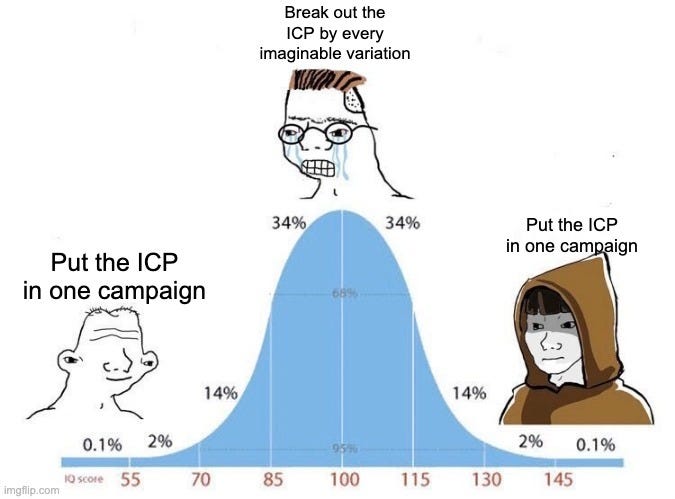
Last year, we rolled out our ABM “grand plan” that, while I still fully stand by + resource based on, may have been a bit grandiose when it came to translating that into campaigns. We had 3 tiers of accounts, 3 different global regions, 2 core personas within those, and then 4 different types of content to be served. On paper, fully reasonable. But when you look at the total combinations here, that means 3 x 3 x 2 x 4 = 72 campaigns to manage and split budget across…😅
Which led to the “whiplash” moment of getting an experiment back in play to see if we should keep the 72 detailed + specific campaigns going, or if we simplify things back down + reap the benefits of unit economics when it comes to CPMs (cost per 1000 impressions served), CPRs (cost per 1000 unique members reached), etc.
What I’m seeing
So far, it’s promising.
In terms of CPMs…
Control group: $75 in North America, $35 in Europe
Experiment group: $40 in North America, $20 in Europe
✅ 47% + 43% decreases, respectively
In terms of CPRs…
Control group: $452 in North America, $298 in Europe
Experiment group: $118 in North America, $66 in Europe
‼️🤯 74% + 78% decreases, respectively
Lastly, looking at CTRs as a proxy for engagement (note: core variables remained constant - single image ads + “Reach” objective)…
Control group: 0.68% in North America, 0.66% in Europe
Experiment group: 0.61% in North America, 0.79% in Europe
North America is down 10%, but Europe is up 20%
Ok, so North America is “down” and Europe is “up” - is that “down” number in North America worth it? Let’s play this one out with the math…
Say I have $10,000 to spend, at these rates, what does that look like after the campaign has run through the budget for North America (the “down” campaign)?
Control: ($10,000 / $75 CPM) x 1000 = 133,333 impressions x 0.68% CTR = 907 clicks
Experiment: ($10,000 / $40 CPM) x 1000 = 250,000 impressions x 0.61% CTR = 1525 clicks
Conclusion: the 47% decrease in CPMs > the 10% decrease in CTR. Experiment will drive 68% more engagement
Note: yes, this is not a perfect experiment + is making assumptions that aren’t perfectly linear, but when I see a number come out that is this strong, it tells me that this is directionally the better path
Creative variations
Context
I just scrolled my LinkedIn feed + here’s the breakdown of the first 10 ads that showed:
Format
Static: 6
Video: 2
Thought leader: 2
Background color
Blue: 4
White: 3
Gray: 2
Brown: 1
Message/offer
Generic product pitch: 4
“You aren’t doing your job right”: 2
Target member’s desired result: 2
Contrarian opinion: 1
Gift card for demo: 1
I used to joke with my Refine Labs clients back in the day that it’s not hard to stand out in a feed full of blue, single-image B2B ads patting their product on their backs
…and it turns out not much has changed in the past ~4 years as that’s how my feed is still looking today.
So my hypothesis is one that most all marketers hold: if I zig when everyone else is zagging, will that draw in more eyes?
Which led to the experiment:
Lo-fi instead of hi-fi
Handwritten instead of typed
Tell a story instead of feature dumping
Hold a POV instead of sharing a platitude
Focus on the prospect instead of the product
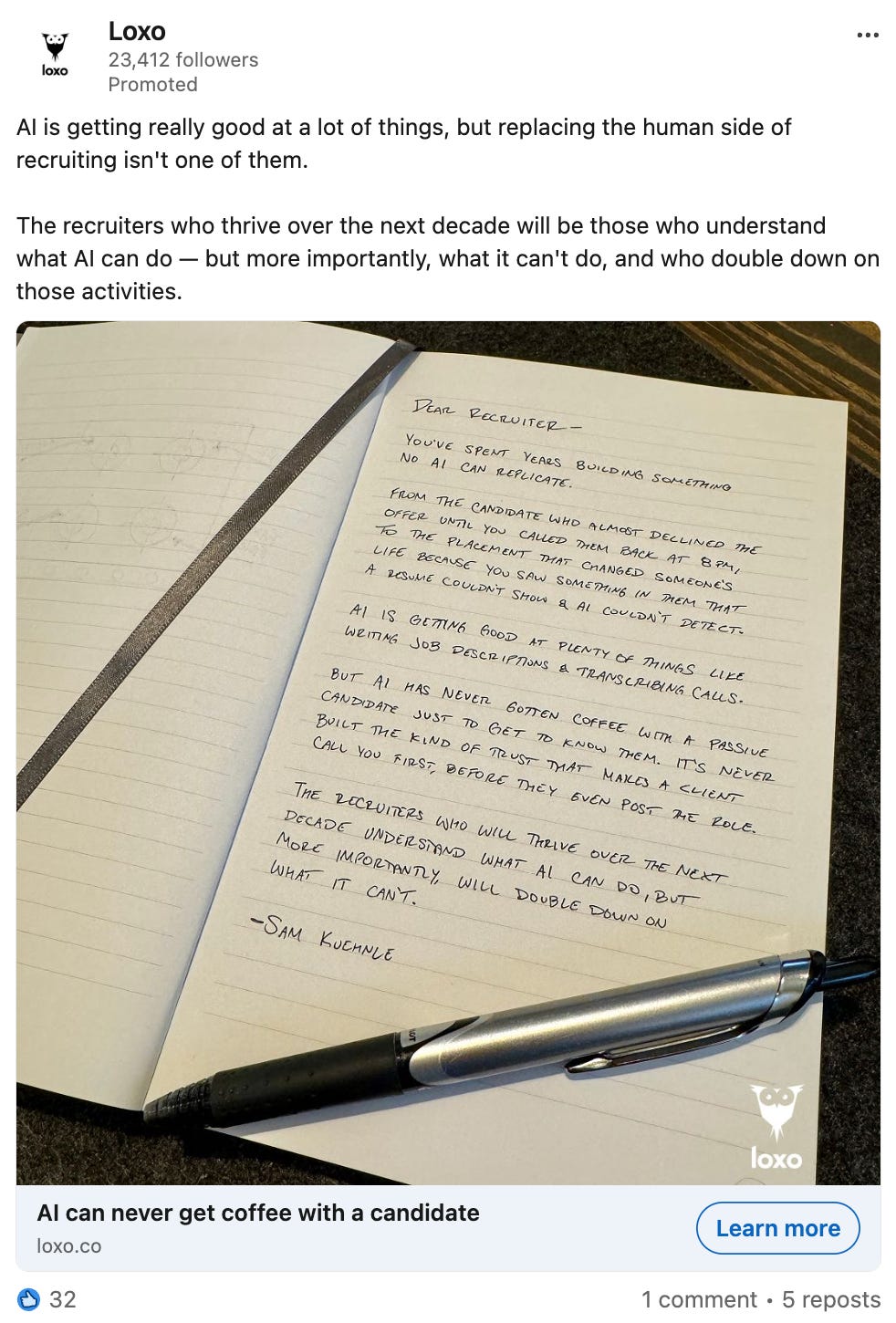
Which led to this letter I “wrote” to the recruiter who is fearful of AI replacing them and what the future of their profession looks like.
What I’m seeing
This one was launched this week + with an experimental budget (read: < 1% of daily budget), so things will likely level out next week, but the initial results have been strong:
0.73% CTR (compared to industry “benchmark” of 0.3%)
32 likes (yes, this can be a function of spend, but as noted above, this has received 1/1000th of the budget of other ads that have been running for > 60 days and still don’t have 32 likes)
Average dwell time of 6.44 seconds (compared to ~4 seconds for our other single-image ads using the same bid strategy)
Conclusion
I overthink things all the time. As a result of that, I have a lean toward accidentally overcomplicating things as well if unchecked. And as my friend Paul Stansik coined years ago, there’s a big difference between simplifiers and complicators.
The “complicator” version of me says make a campaign for each variation of tier x region x persona x content type because it’ll be highly relevant in that case.
The “simplifier” version of me says if our ICP is truly our ICP, ICP x regions will get to that same outcome, but with significantly less resourcing required + more efficiences of scale.
The “complicator” version of me says let’s make ads that showcase the beauty of our product and the value a prospect can get from it.
The “simplifier” version of me says let’s make something that’ll stand out from everything else in the feed + then resonate at a human level by demonstrating empathy instead of being yet another “come buy me!” message.
These experiments reinforced something I've always believed but tend to forget when I'm building campaigns:
The best performing things are usually the simplest things. And the beauty in this is that 1) they’re easy to spin up by nature and 2) are doors that you can walk back out of if they don’t pan out.
If you've been sitting on an idea for an experiment lately, ship it. You don't always need a huge budget or to go through all the formal channels to get something created. Dip your toe in the water to get a sense for if the experiment validates your idea first. And if it does, great, then you can take those findings + really expand things out from there. But most often, we get caught up in thinking we need to set it up as if it’s already proven before taking that first experimental step.
See you next Saturday,
Sam
P.S. if you’ve run an experiment lately (or are thinking about one), reply back + let me know what you’re thinking! I always love geeking out over these types of things and yes, I read every response that comes back from these emails :)