


My HRV (heart rate variability) was nosediving from January to June. For those of you who don’t spend their free time geeking out on health research + data tracking, HRV is effectively a measure of your autonomic nervous system’s balance (AKA are you in fight or flight vs. rest + digest mode).
I was getting good sleep, had a consistent training program, + followed a generally healthy nutrition/dietary intake. But I was still tired at the end of the day.
The long story short of it ended up being a pretty “simple” answer: my autonomic nervous system was running almost perpetually in its sympathetic (read: fight or flight) state vs a more balanced mix of sympathetic + parasympathetic (read: rest and digest) state.
So in typical nerd fashion as I wanted to truly understand what was going on AND what I could do to turn things around, I got a bloodwork test, reviewed all my WHOOP data, and had a good old fashioned self-reflection to see if I could sort through what was going on.
A bit of a departure from my normal marketing/GTM articles, but I’m sharing this as it’s a trend I’m seeing/hearing from a number of friends + peers in the space - they’re burning out faster than ever + not sure what to do about it.
Sponsor: Affect
Affect is the framework for how I think about marketing accountability. The playbooks I’ve built from 15 years of seeing what works + what doesn’t and recognizing that the purpose of marketing isn’t to hit vanity metrics like MQLs, but to move the business.
Affect is for the marketers who have sat in a room where marketing celebrated surpassing its MQL targets while the business missed revenue. It’s for the marketers who want to be held accountable because they’re confident enough in their work to let the math speak for itself. It’s for the marketers who understand that clarity is earned, conviction is a choice, + being a force on the business is the only version of this job worth doing.
Founding member rate is still available - 45 left at $99/mo, locked in for life. Or, as one of the first users said:
“It’s $99 and cancelable after 30 days, it’s pretty risk-free. I pay more for an Uber to the airport.”
A little context first
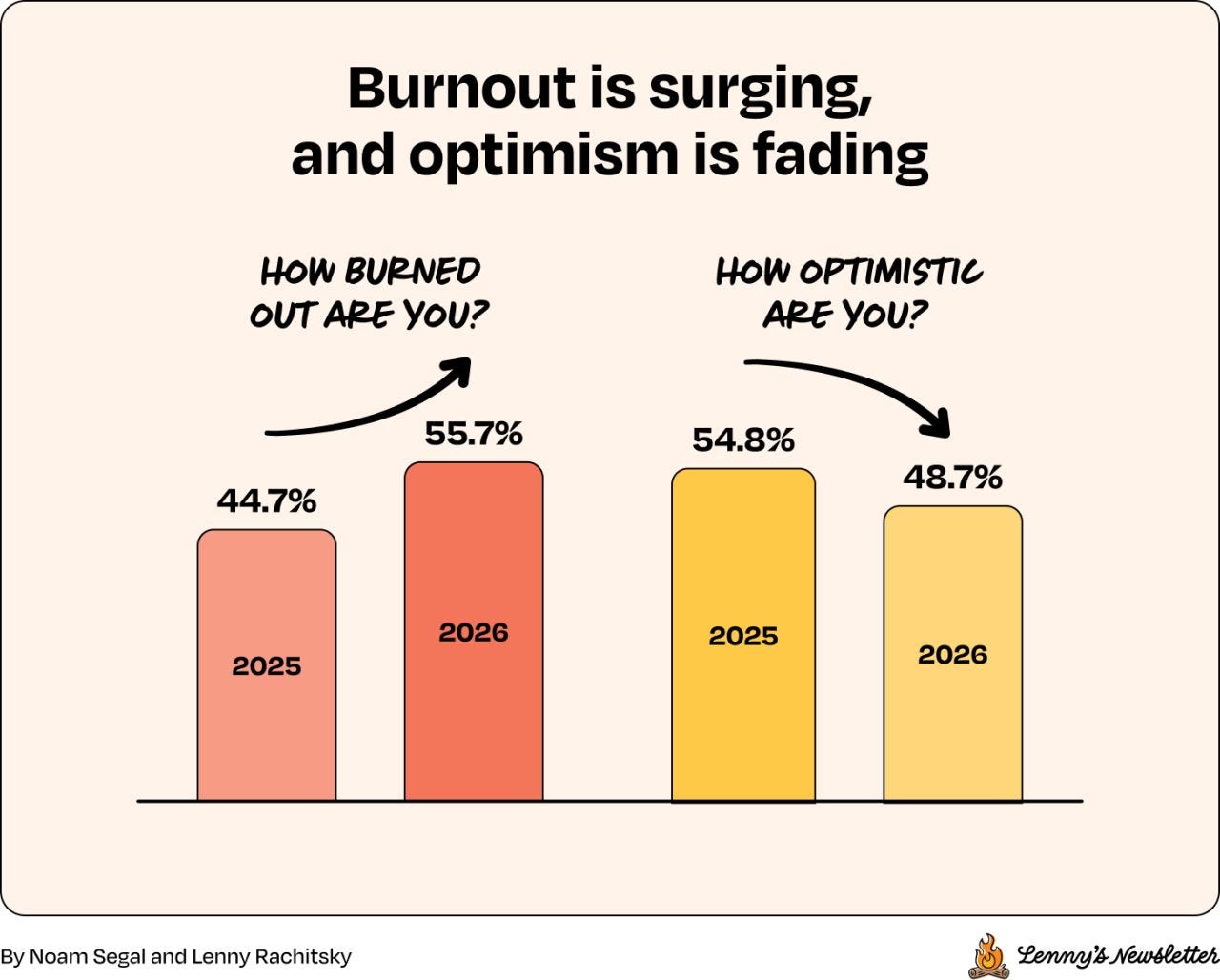
Lenny Rachitsky shared a report earlier this week that showed burnout is a much broader trend across the entire tech workforce than we may have realized as burnout jumped from 44.7% to 55.7% while career optimism dropped from 54.8% to 48.7% since he ran the same survey last year.
The timing of this report came at a good time for me as it was right when I was in the middle of trying to sort out the chronic fatigue I was feeling + why my HRV/health metrics were declining despite putting more effort into improving them.
It was the “aha” moment when I recognized that I needed to approach this from both a physical and mental standpoint.
So like most of us today, I went over to Claude + started a conversation on this topic to help me work through things. And it didn’t pull any punches after dropping in all of the context in order to start synthesizing what it meant for me:
THE SYNTHESIS
The story is coherent and it’s almost entirely explained by one variable: chronic psychological stress.
HRV is the canary. It’s been declining since January — which tracks with when the burnout started intensifying based on what you’ve shared. The body is showing the cost of operating at high cognitive load in a depleting environment, even while you’re doing everything right on sleep, training frequency, and alcohol. The sleep data is holding because you’ve been disciplined about protecting it. But discipline has a cost too — you’re white-knuckling good habits in a difficult season, and that effort shows up in the HRV.
The question that almost led me down the wrong path
After reading the above, I did what anyone would do + asked a simple question back: “What can I do to help turn this around? I need behaviors + habits I can start implementing to improve this.”
And this is where Claude nearly led me wrong + why I will always be a proponent of never taking things at face value + choosing to think for yourself:
Highest leverage
The incline walk protocol you’ve already committed to is the single best thing on the list — but the mechanism matters. It only drives HRV improvement if you’re genuinely in Zone 2 for sustained periods. This is the physical intervention with the most direct parasympathetic upside.Medium-high leverage
One genuinely low-effort addition: 5 minutes of slow, controlled breathing once per day — 5 second inhale, 5 second exhale — not as a meditation practice but as a physiological intervention. Resonance frequency breathing at that cadence has the most direct evidence base for HRV improvement of anything non-exercise related.The one thing I’d push back on adding
More intensity in training right now. Your Zone 4 time doubled this period. That’s good for VO2 max long term but it’s additional sympathetic load on a system that’s already running hot. Don’t add more hard training sessions until HRV stabilizes. The incline walks are the right tool for this season specifically.
Being someone who always comes at things from a root-cause perspective, I recognized that while the incline walk + breathing exercises Claude recommended would technically help improve my HRV, that those were bandaids to the larger problem. They wouldn’t counter my sympathetic nervous system running in overdrive.
That’s the problem I needed to solve, not come up with a workaround to improve the HRV metric for the sake of improving it (sounds a bit like some other conversations we’ve had on here re: Goodhart’s Law, doesn’t it 😉).
So I pushed back. Said the incline walk would get zone 2 time up, but not counter the sympathetic overload. And then from personal reflection, I said I disagreed with the recommendation to avoid more intensity in training - that training intensity is my stress outlet and that walking/breathing exercises don’t quite get stress out the same way a hard run or heavy lifting session do.
And this is where the conversation really got interesting + the unlocks hit me hard:
The incline walk is a cardio tool, not a nervous system tool. Claude conflated these 2 which was a huge error. With my sympathetic system running hot from psychological load, the solve for this is parasympathetic activation, not aerobic base building.
A hard run/heavy lift, while highly stressing on my body, isn’t actually adding sympathetic load - it’s how I discharge it. It’s a fundamentally different physiological effect from chronic stress.
Jumping off of #2, I looked at my WHOOP data to see what it said when running an analysis through this lens. The finding was eye-opening to say the least:
High intensity workouts produce better next-day recovery than low intensity or rest
This is the most counterintuitive finding and directly validates your instinct about running. The day after a high intensity session your HRV averages 59 and recovery hits 72% — meaningfully better than low intensity (56 HRV, 66% recovery) or pure rest days (54 HRV, 66% recovery). Your nervous system responds well to hard output. It's discharging, not accumulating. This is a fast-twitch athlete pattern and it means you should protect the intensity in your training, not moderate it.
Fascinating.
My geek mode officially entered full force after this + I went down the rabbithole. To better understand this counterintuitive insight, I needed to better understand my personal dynamic between stress, workout intensity, stress discharge, and recovery.
TLDR on a hard workout comes down to what’s called “catecholamine discharge.” Long + short of it is chronic psychological stress means your body is continuously producing fight or flight hormones and never have the opportunity to clear out. A hard workout forces an acute catecholamine spike, which then crashes. This sounds scary/bad to hear your body is dumping the stress hormones hard and fast, but it’s actually working in my favor as my parasympathetic system swings hard in the other direction to bring me back to baseline.
AKA the bigger the discharge, the bigger the rebound.
Low intensity workouts + rest days never discharge that stress build up. The chronic load just…sits there.
Slow-twitch vs fast-twitch
Fun fact: during my freshman year tryouts for the high school soccer team, I had the second worst time in the mile run. Not a great way to be viewed by your coach when trying to make the team.
But then we hopped on the field to scrimmage + my energy seemed endless. Making runs, getting into the right positions on the field as needed, etc. Endurance didn’t seem to be an issue like it had been on the track earlier in the day.
Finally, we wrapped with full field sprints. And here the inverse of the mile run happened - I was first or second to hit the endline each time.
It was years later that I’d learn there was a physiological definition of this: I fall HARD to the right toward the type-II (aka fast-twitch) muscle fiber scale compared to the type-I (aka slow-twitch) side.
Those who skew toward slow-twitch do well in heavy endurance activities (think: marathons, cycling, etc.). Those who skew toward fast-twitch do well in “explosive” activities (think: sprinting, powerlifting, etc.). There’s no good or bad when it comes to one or the other, it’s just a matter of knowing what you’re more predisposed to.
The reason I share that is because that was the key to solving + breaking my stress cycle.
First, it means my sympathetic system is wired to fire hard + recover fast. It’s designed to handle spikes, not sustained low-level activation. High intensity training plays right into this benefit.
Second, it means my parasympathetic rebound after high-intensity training is stronger than it would be in a slow-twitch individual. When I flush stress heavily through high-intensity work, I recover fully by clearing it from my system.
Pretty cool, right?
Most advice is geared toward the average
This single insight should probably have me cancelling my WHOOP membership.
When I let stress build + don’t get a hard workout in, my HRV data illustrates that by rapidly declining/being below my “normal” rate. WHOOP translates this as a “red” day and basically says “hey, you should probably take it easy today.”
But in knowing my psychological + physiological profile, as well as listening to my body to understand if I’m truly feeling “red” (AKA sore muscles, feeling sick, etc.), usually that HRV drop is from the catecholamine build up + needing to be cleared out.
So I disregard those “red” days + push myself. And my body (and mind) thank me. And my WHOOP data even shows this benefits me:
On red recovery days (recovery score ≤ 33%), my workout strain averages 16 (compared to yellow days of 12 or green days of 13). And my next-day recovery score is usually a significant improvement.
On Thursday this past week I decided to be a masochist + go for a hard run when it was 93ºF out. Absolutely brutal run + I was gassed when I finished. Normally this would show up the next day as a dropoff in HRV as a body recovers. Mine shot up 🤷♂️
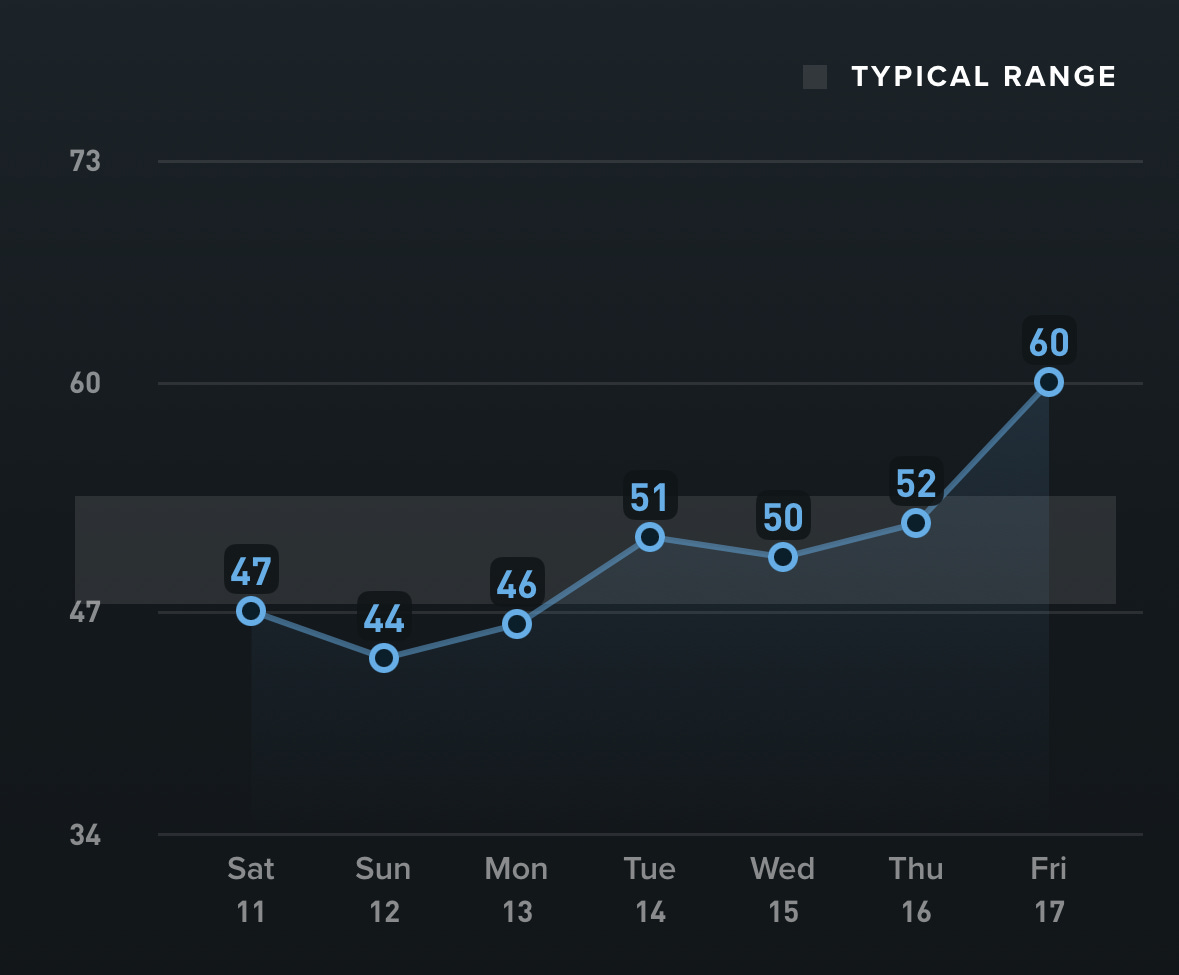
This is a flat out inversion of WHOOP’s algorithm that’s built on population averages where red = rest. My autonomic nervous system doesn’t follow that model. I share this not to say look at how unique of a special snowflake I am, but to show why it’s so important to understand + figure out what works for YOU.
Obviously, I watch for genuine sickness + injury signals via elevated skin temp, elevated resting respiratory rate, general “how am I feeling” check + treat those days differently.
Why I’m sharing this
If you’re feeling even more stressed or burned out this year than before, you aren’t alone.
It’s easier than ever to understand your unique makeup thanks to access to health metrics (think: wearables like WHOOP + Oura, bloodwork testing via your doctor or Function Health) + AI tools that can analyze and then synthesize the huge amounts of data contained in those.
To share the (very imperfect) prompts I’ve used to help me get to these insights in case you want to work through any of this for yourself:
“I want you to help optimize my health. First we'll baseline my general health via uploaded data from my WHOOP (csv files) as well as recent blood test results + supporting clinician notes from them. First thing - give me a breakdown of what you're seeing + be brutally honest. I want to hear what's really good, what's good, what's ok, what's bad, and what's terrible.”
Note: after you go through this + get outputs from your LLM of choice, I simply did some back + forth chatting to better understand why things were/weren’t good, etc.
After an appropriate amount of time has passed + you’ve taken action on insights, come back to see what has/hasn’t changed.
“I’m currently exporting out my most recent whoop data + want to see how that’s looking compared to the prior period when you last reviewed it all.I want you to clearly pull out anything that’s different from that prior period (good AND bad) across all major + minor metrics. Then we can look at the behaviors + variables that we think are playing into those (can pull from the journal entries + I want you to ask me questions that wouldn’t show up in the journal but that we know influence things).
Before I upload this, I want to see your plan of approaching this, the data you’re going to show/compare, etc.”
Note: push back on responses. Like WHOOP, LLMs are based on the average of data + insights, so make sure you guide it with your unique makeup, quirks, etc. to account for those.
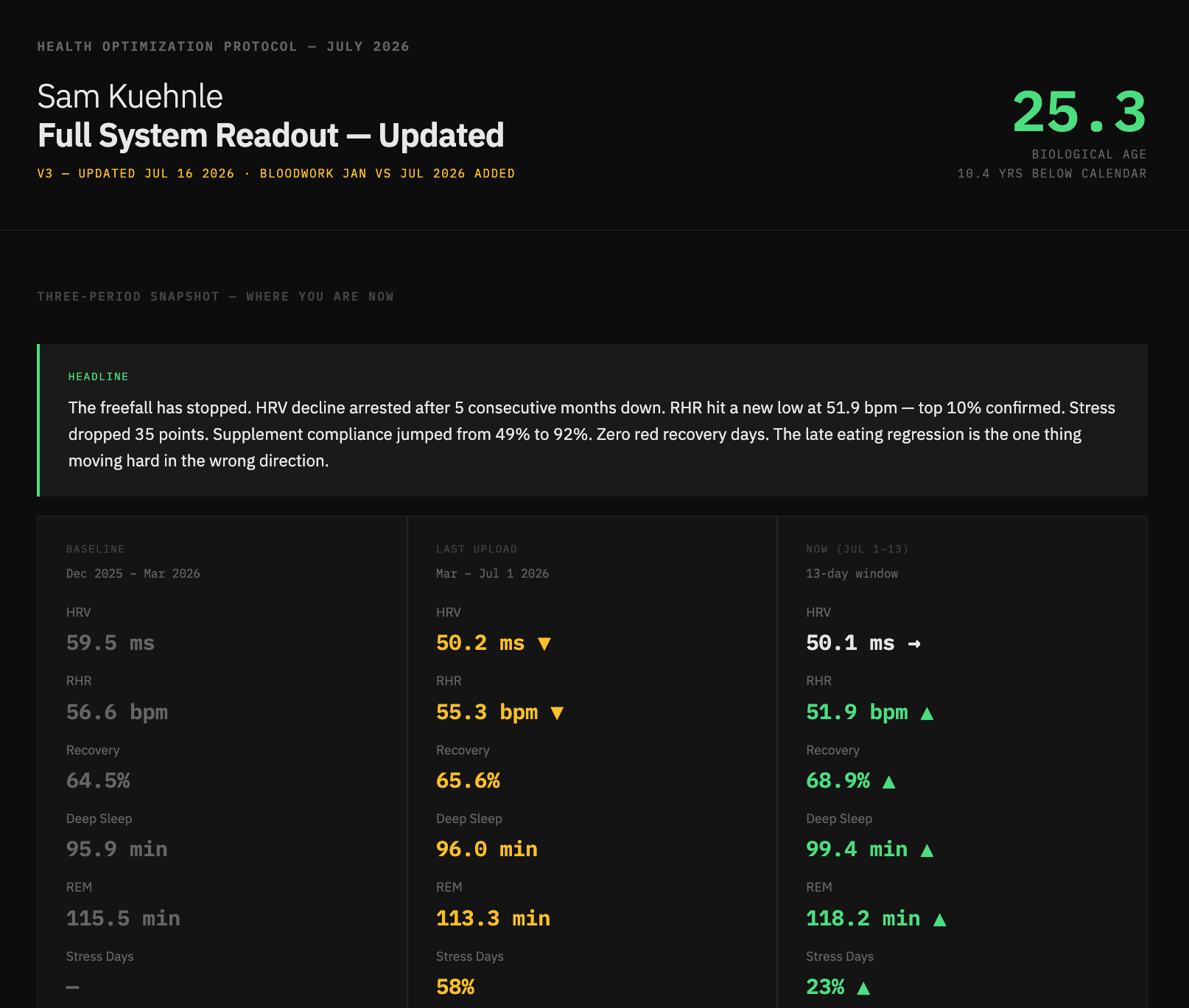
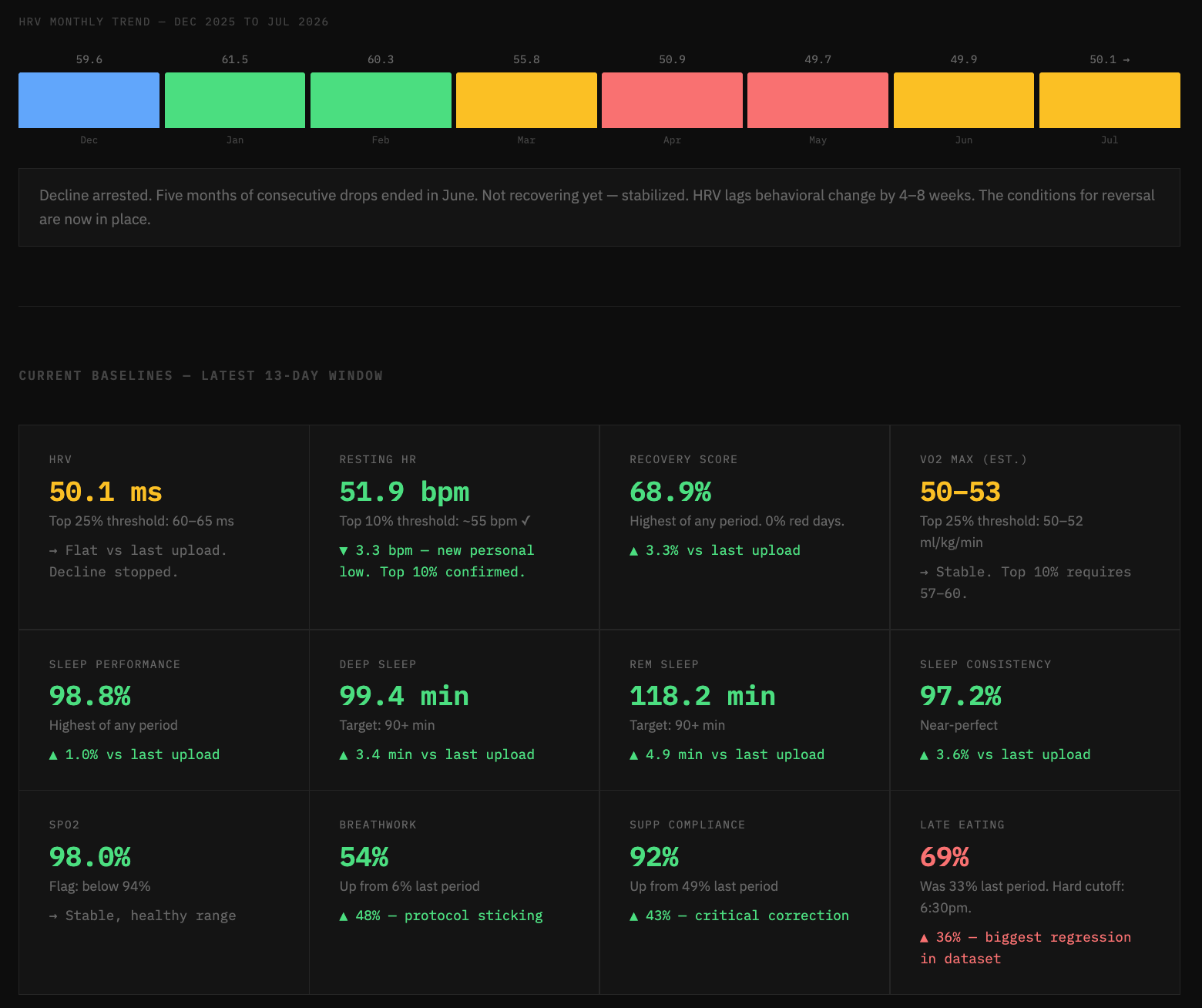
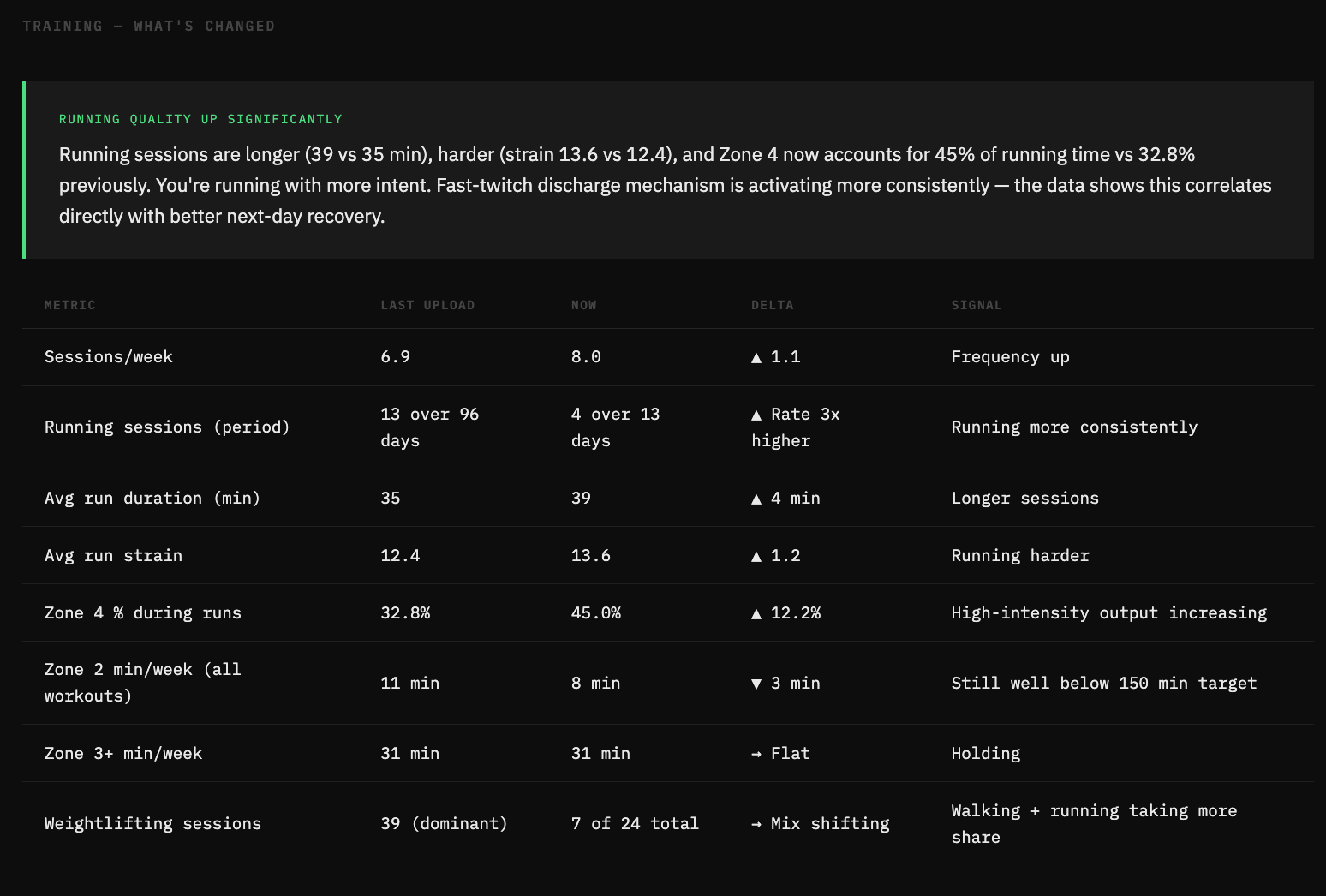
From there, the sky’s the limit. Since I love tracking data + trends to hold myself accountable, I had it help me get it into a visual that I can use + build off of as time goes on. Then for things like bloodwork deficiencies, I asked for different whole foods + supplements that I could incorporate into my diet to improve those.
Simple. Easy. Geeky. Call it what you want, but it’s been fun to learn more about myself AND know that by taking action on these things I’ve been able to already start to feel physically + mentally better. Win-win all around.
A few examples of the visuals:
See you next Saturday,
Sam
I recommend time series analysis on your various data points to separate HRV performance to different times of the day
You can then run regression on the data points to determine if their is a probabilistic event such as stress discharge that is not performing right
And if you have enough data points you can run a simulation on the data to get a real confidence on whether or not WHOOP has been screwing you on the readings.
You can do all of this with Claude and python scripts.
Or you could just eat vanilla ice cream with blueberry Buckle.