


You can spend your way to brand awareness, but not demand creation.
A few years ago, I remember that every time I went to YouTube, I saw an ad for Monday.com. Literally every. single. time.
Their “saturation strategy” worked incredibly well when it came to brand awareness. I can still tell you exactly what they do (project management software) + I definitely know their name.
…but I can’t tell you how they’re different from their competitors like Asana, Trello, or Basecamp. I never felt like I was missing out by not using them. They never gave me a reason to switch. They were just... another option. Spending their way to visibility but not conviction.
Their ads were very successful in that they got my attention + communicated what they do, but they never convinced me WHY they are the only option I should go with, what they provide that's different from their competitors in making their customers more successful, or added any value to me that positions them as THE experts in this space. If I got a survey from YouTube or a third-party firm asking if I had heard of Monday.com, the answer would be a resounding yes.
Sponsor: HockeyStack
Imagine you have a deal sitting in your forecast that’s expected to close, only for it to stall because no next step was scheduled. Or because the decision-maker stopped engaging.
These signals are often unnoticed until it’s too late. The team doesn’t think anything of it when the decision-maker hasn’t replied for a week or two - “they’re probably just busy.” Having an agent that identifies this risk + also proposes a recovery plan (i.e. finding a new champion there + proposing how to engage them) is the natural evolution of how agents should support our efforts.
HockeyStack’s new AI Revenue Agent brings use cases like this to the forefront so GTM practitioners can keep + win the pipeline they worked so hard to generate. This is the future of AI agents in GTM.
So why didn’t it create demand?
If they asked if I considered buying their software in the next 12 months, the answer would be no. Why? Because they didn’t *create* any demand.
They didn’t give me a sense of urgency around what I’m missing out on by not using them
I didn’t receive any compelling feeling that they are THE project management platform I should use
They didn’t educate or provide me with any value with insights that they uniquely know as experts in the space
They didn’t communicate any unique point of view or demonstrate any real conviction about what they do
Long story short, they didn’t break out of the commodity bucket - they’re simply another option.
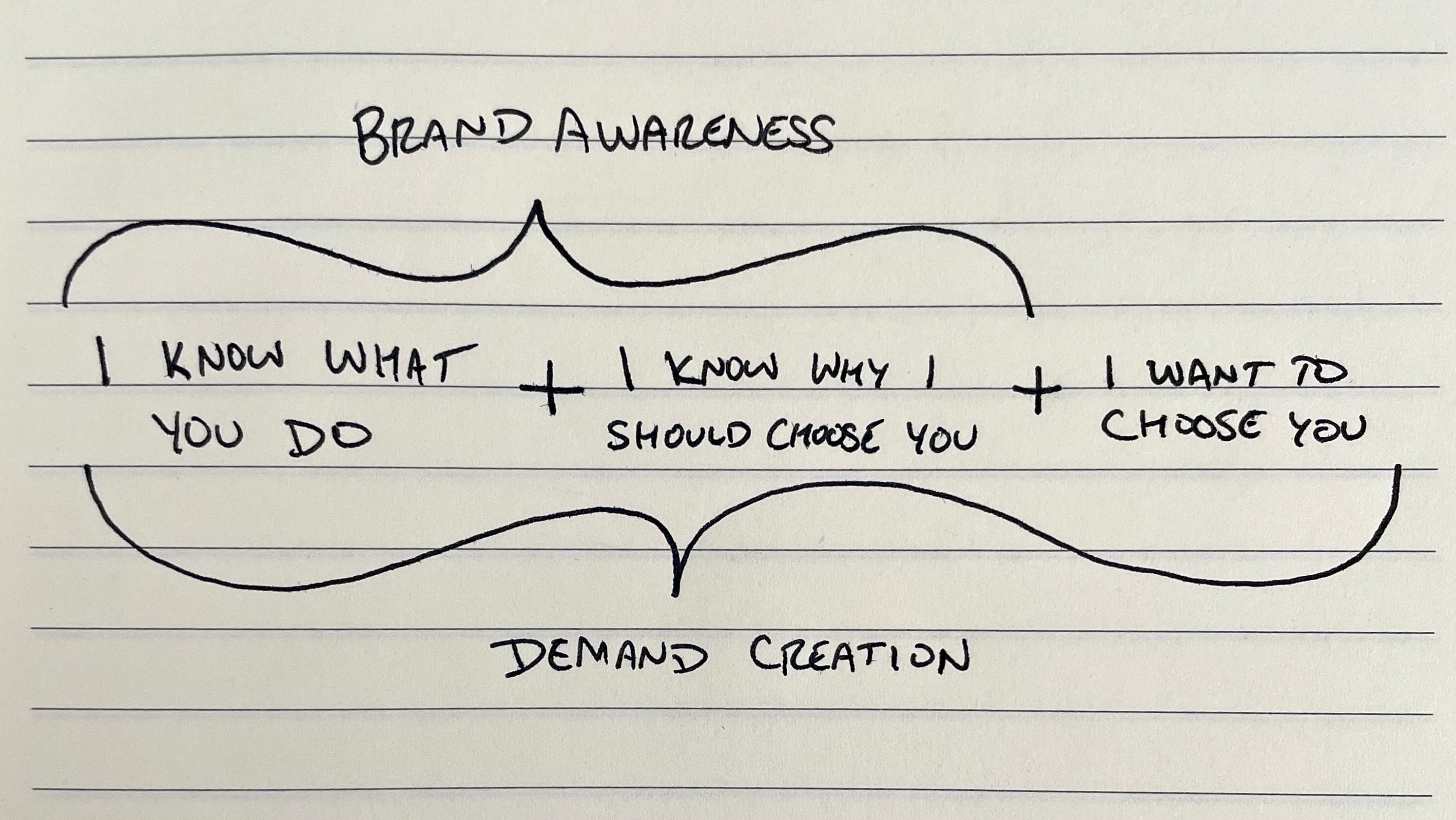
Brand awareness says “Here’s what we do” or “Here’s a memorable tagline,” but demand creation says “Here’s what we believe is broken + why we’re the only ones fixing it correctly.”
First one is yelling really loud into a megaphone + hoping people hear it. The second one comes from a place of conviction + is building a cult.
Building conviction
A few weeks ago I wrote about why companies should have manifestos instead of mission statements. The reason for it is simple: a manifesto forces you to take a stand. I’m also a fan of anti-manifestos + writing a “here’s who we’re absolutely not for.”
Once you have that, the conviction comes through in how you do (or don’t) internalize that.
It changes who you hire
A “butt in the seat” isn’t going to be the answer to growth. We need to hire experts who believe what you believe + can teach the market why they should too OR people who are passionate + interested in learning about that so they can them help educate others about it.
It changes what content you create
When you see fuffy + surface-level content, you get hives and can feel yourself recoiling in disgust. You’re driven to teach + share knowledge that can only come from someone who truly understands the space and you can sense their enthusiasm/conviction behind the content.
It changes how prospects see you
They recognize that you aren’t trying to convince them that you’re “the best [insert any category name] software”. They can see + feel it within 10 seconds.
And this is what ultimately creates demand.
Leveraging internal experts
The true inflection point of where a company will/won’t succeed here is if they have the conviction, but they don’t figure out how to operationalize it.
AKA they write the manifesto, but it just sits on the website buried somewhere in the nav. Meanwhile the demand gen team is running the same old product/feature ad campaigns + the SDRs are using a generic pitch. The conviction never makes it into how you engage the market.
Long-term demand creation requires you to intentionally build + hire (or develop) for expertise. Having the ability to execute well is table stakes, so the people who are passionate about the space deeply enough to want to teach it or find ways to innovate within it are the ones you want.
That type of knowledge, passion, + conviction is hard to fake as prospects can feel the difference between the company that’s trying to sell them something + the company that actually knows how to solve this problem because they’re obsessed with it.
That’s the new 10x moat + is why we’re seeing a few brands really break out in wildly saturated categories this year.
What this looks like in practice
Let's break this down side by side:
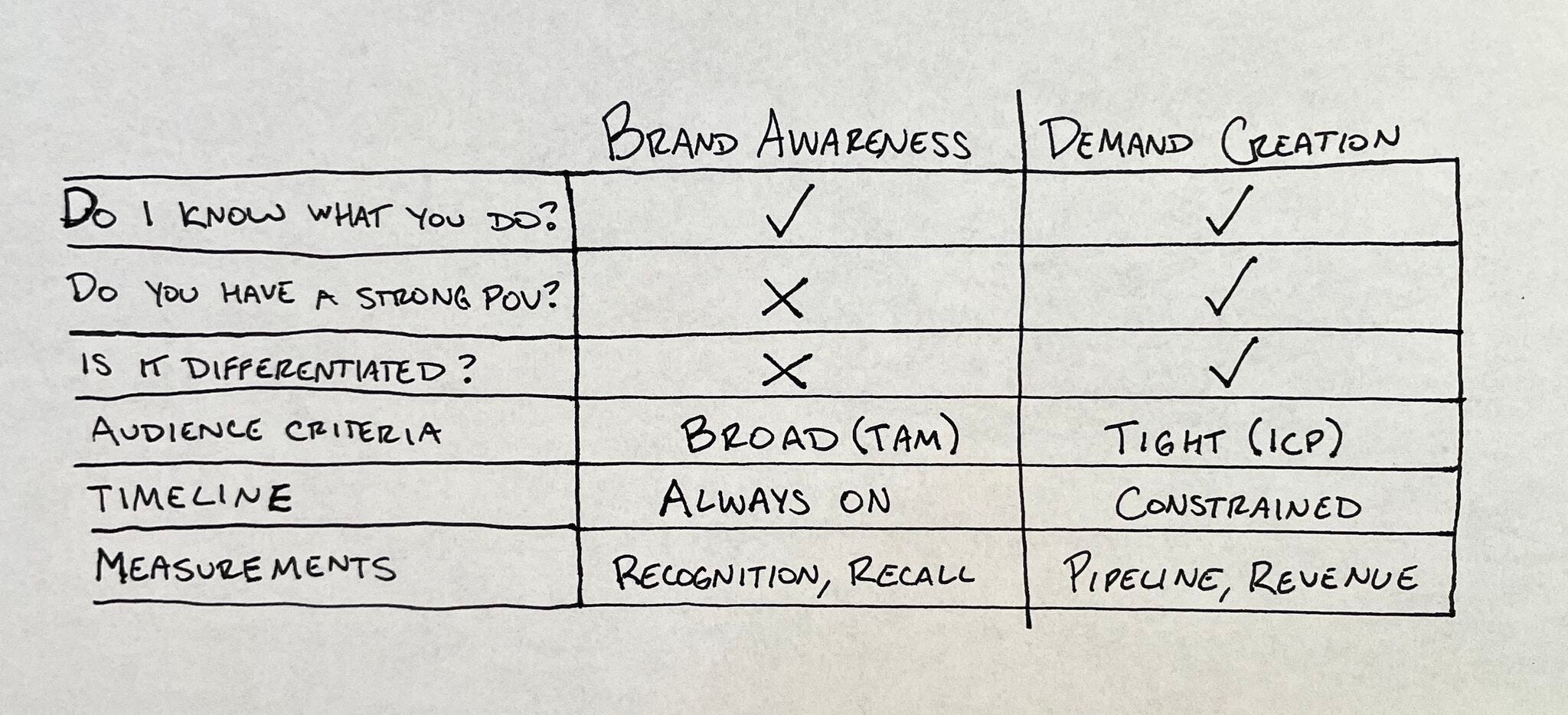
Brand Awareness
Messaging: high-level with a focus on answering what you do and/or a memorable tagline
POV/differentiation: NO strong POV/differentiation statement
Audience: total addressable market (broad + large)
Timeline: “always on”
Measuring success: brand recognition + brand recall
Execution: spend a LOT of money on reach + frequency
Demand Creation
Messaging: high-level with a focus on answering what you solve for
POV/differentiation: VERY strong POV/differentiation statement
Audience: ICP (smaller + specific)
Timeline: constrained by success measurements (next point)
Measuring success: pipeline + revenue
How you build it: take a stand, hire those obsessed with your product/industry, + teach this via your content
Put simply, you can drive brand awareness without creating demand, but creating demand requires more than driving brand awareness.
Measuring on a constrained timeline
So this is all very easy to say, but what does it actually mean?
When you’re creating demand, you want to constrain your timeline to understand if the marketing efforts you make today are driving noticeable increases to your pipeline + revenue numbers after a few quarters.
Brand awareness is always on because the goal is increasing brand recognition and recall. The longer you’re out there and the more you spend, the more those metrics go up. But those metrics don’t always mean success on the pipeline and revenue side.
And that’s why for demand creation, driving increased brand awareness isn’t a guarantee that you’ll successfully create demand. You can’t spend your way to pipeline and revenue. Creating demand is more surgical. So the timeline portion is basically saying, “We’ve been doing this for 1-2 quarters now, are we beginning to see actual pipeline + revenue numbers starting to increase?” If you’re successfully creating demand, they will be as you’ve reached the right prospects and with a message resonating in a way that makes them want to switch/buy.
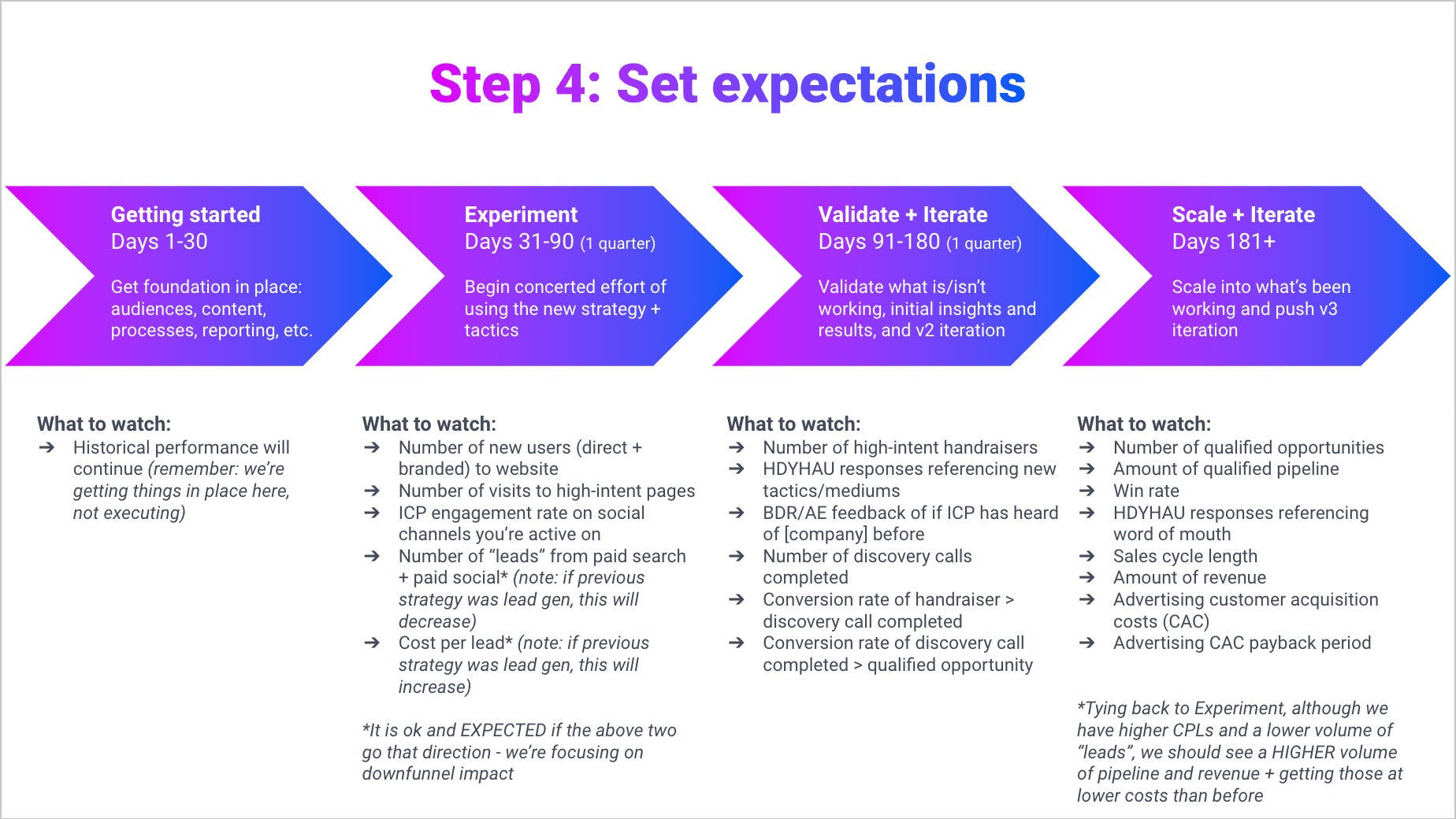
To steal a lesson from an article I wrote about setting expectations + measuring success, you can refer back to this timeline and the “what to watch” KPIs as time progresses. If you’re creating demand, you’ll be moving along this timeline appropriately. If you’re only driving brand awareness, you’ll stall out at the Experiment stage KPIs.
Demand creation is harder to do than brand awareness since it’s more of a function of “who has the most conviction in the category” than it is “who has the most funding in the category.”
But it’s worth it because the prospects who do share your worldview need zero convincing - they’re already sold on the idea, all you have to do is show them you’re on the same page re: that belief.
This is how I believe demand is created in 2026+ and time will tell if this hypothesis is valid or not.
See you next Saturday,
Sam
P.S. Here’s a fun Spotify playlist for marketers entering The Conviction Era ❤️🔥 - sent this out to all of the Affect customers who’ve signed up this past month + thought some here might appreciate listening in 😊