


LinkedIn CPMs are up 200% over the past 2 years.
You may have thought you were going crazy + that despite scaling your ad spend on LinkedIn because “it’s working,” performance was staying relatively flat…well, this may be a big reason why.
I was chatting with Keith Putnam-Delaney (Co-Founder + CEO of Primer) the other week + he dropped that stat on me. I knew costs had been trending up for awhile, but I never zoomed out over that kind of time horizon to see just how much costs had inflated there.
Well, turns out he was right, AND that 200% may even be a conservative number (below are the CPMs we had in my last role when looking from 2024-2026 - a 255% increase despite my neurotic oversight on optimization + efficiency 😅).
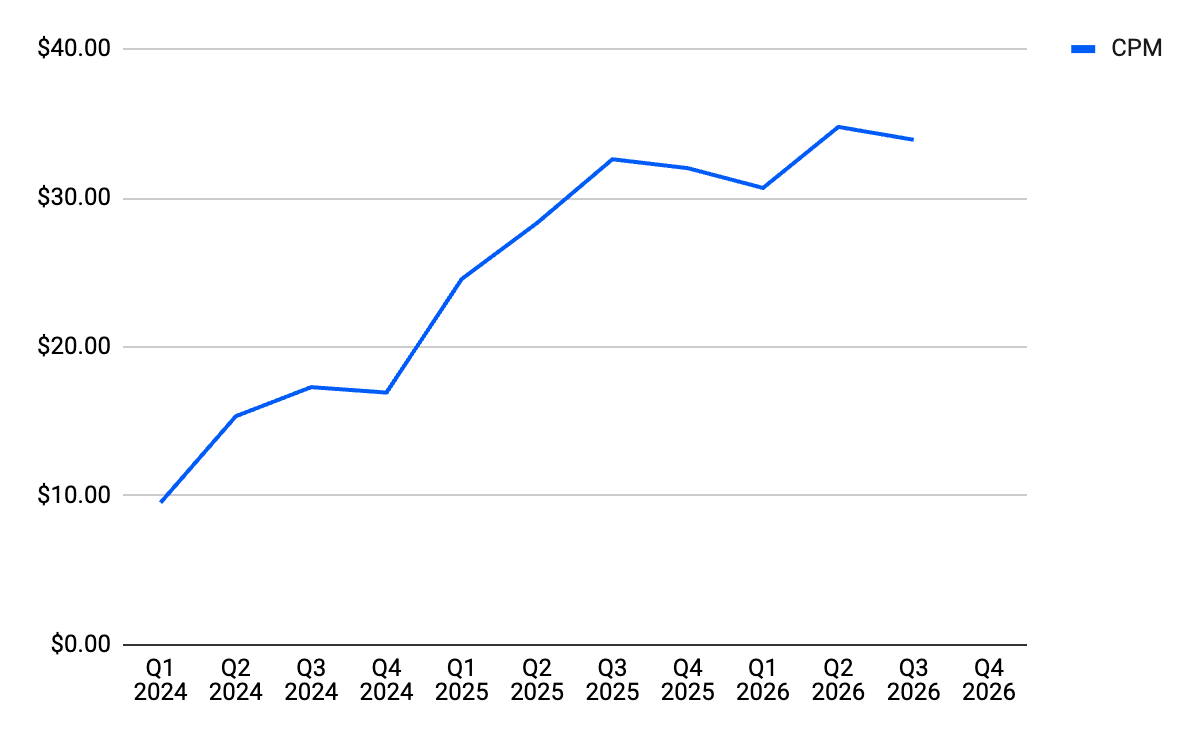
Even with these rising costs, 94% of B2B still advertises on LinkedIn because…well, most audiences spend at least some time on there or it’s the only way we can have a reasonable level of confidence that we’re targeting the right people.
So we have rising CPMs (cost per 1000 impressions), ever-increasing CPLs (cost per lead), more competition entering the ad auctions, an ungodly amount of slopdusting all over the feed, + one more thing - their attribution is getting worse too 🙃.
Sponsor: Primer
Outbound is broken + LinkedIn somehow keeps getting more expensive. Now what?
Every B2B marketer is paying premium prices for the same shrinking pool of attention on the same two channels (LinkedIn + Google).
Meanwhile, channels like Meta, YouTube, + display cost a fraction of LinkedIn…but most B2B teams can’t use them. Standard account lists match at 15%, AKA audiences are too small to learn + too noisy to convert.
Primer fixes the match rate problem. They turn your ICP, target accounts, and net-new prospects into 45-85% matched audiences across every major ad platform. Now the efficient channels we couldn’t use before due to low match rates are suddenly usable.
Get started with a free account + 30-day trial of paid plans today!
Fun fact: Rippling credits them for their $145M Series B success.
Wait, how do we know where to invest then?
I promise I didn’t set out for this to be a newsletter that bashes on LinkedIn, but this initial context is important to understand why we’re seeing the budget + channel shifts that we are.
Across all of the customers Primer is hooked into, Keith stumbled onto something really interesting:
"What's really interesting is the LinkedIn click identifier data is actually getting getting worse.
So for whatever reason, across most of our customers, we're seeing that your ability to attribute conversions to LinkedIn is actually degrading, whereas it's sort of staying flat for Google and Meta, which is weird."
More specifically, this is the underlying analytics metadata that the data is degrading. Ad platforms always over-report their impact (hence why we’ll see 3-5x more “conversions” in ad platform reporting than we do in something like Google Analytics or Dreamdata). So whether it’s LinkedIn becoming less effective at converting users, an increase in cookie + script blockers, fewer purchases being made in today’s economy, or any combination of the above, the ROI here has been steadily rising for a few years + companies are finally being forced to think about where they should invest their ad dollars to get the most bang for their buck.
So where’s the budget moving to?
Meta (AKA, Facebook + Instagram).
"We're seeing budget move into Meta for the first time. More in the last nine months than the previous period.
So B2B is starting to make its way to Meta and we've seen about a 5-10 percent, depending upon the cohort, rise in investment in Meta."
Interestingggggg…
But also not. When channels start to lose their efficacy, we demand gen marketers are always on the hot seat thinking “oh shit, here we go again. I just figured out our channel mix that works + now a new wrench has been tossed in.”
Hey, that’s why we love what we do right? Never experience the same day twice + always new problems to be solved.
So based on the initial insight of the newsletter that LinkedIn costs are absolutely taking off, I assumed that the budget that’s migrating over to Meta was either 1) being repurposed from LinkedIn or 2) additive ad budget.
Wrong.
Enter curveball number 2 from Keith:
"Actually some of it's being pulled from Google, not just LinkedIn. We've seen about a 4 point drop in budget towards Google.
Which kind of makes sense, right? AI overviews are making it harder to make Google paid search work, I would say.”

We have LinkedIn costs rising 200% + Google’s AI overviews cannibalizing their paid search results, sooooo where is it exactly that we’re supposed to go to reach our market and be able to prove some type of ROI at this point?
Well, sometimes what’s old becomes new again…
Hello Moto Meta
(sorry for the bad throwback Motorola ad reference there)
Take me back to 2020, give me $25k, + I could drop all of that into Facebook Ads AND be able to tell you exactly what every penny drove. Lots of attention was being spent there, they had solid targeting options, and their conversion tracking was MONEY.
Over the following couple of years, first their targeting options were slowly pulled back, then Apple rolled out a new iOS that led to the majority of users opting out of app-tracking capabilities (AKA how Facebook was able to connect the dots between ad dollars + conversions), and that 1-2 punch was enough to drive a lot of B2B ad dollars over to a then-affordable LinkedIn Ads platform.
Alright now that that history lesson’s out in the open, let’s talk why we’re bullish on Meta now.
Audience matching capabilities
In B2B we have lotssss of data. Work phone numbers, work email addresses, work physical addresses, work IP addresses, basically Rihanna wrote a song all about the type of data we have on our buyers (I’m so sorry about the terrible references/dad jokes today - but hey, it’s how you know these aren’t AI-written? 😅).

ANYWAYYYY - long story short, we have TONS of work-specific data, but guess who signs into Facebook, Google, YouTube, Reddit, etc. with their work email?
NO ONE.
And that explains why contact list uploads to the above platforms are usually around 10-20% max - there’s no data to match to since no one registers their work email to those platforms.
But if there’s one big thing I learned during my time at Loxo it was that personal contact info (email, phone, etc.) is out there + accessible, historically it’s just been more expensive + harder to validate, but for a recruiter to be successful in getting someone to leave their current job, they’ve found it’s often not ideal to try and poach them via their current employer’s work email.
So as data has gotten better + more accessible, that’s where B2B data platforms are starting to catch up + is something Keith geeked out a bit on when he said:
"When we sync an audience into Meta, right, we use work email to start, and then we also use the personal emails we're able to find on the individual.
Then we use the mobile phone number. And the individual's zip code, not the company location, but the individual location, as well as things like gender, date of birth, as these are all things that help contribute to an improved match rate, especially on platforms like Meta.”
More simply put - multiple datapoints > 1 low match rate datapoint.
The algorithm (Andromeda)
Ever scroll through Instagram Reels + within 30 seconds are already finding that the videos coming up next are only the ones you’re interested in?
That’s Andromeda at work.
Countless variables + metadata are assigned to every video loaded in + as you watch certain videos (and scroll past others), those datapoints are being quietly being (jk, just making sure you’re still paying attention) stored on the back end to help form a picture of you.
What topics you’re interested in
What job function/role you’re likely in
What hobbies you have
etc.
And those are just what it shows you in terms of the “big buckets” (if you’re curious about yours, head to “Settings and activity” > “Content preferences”), not all of the minute details that it also looks at (AKA your location, etc.)
All of this leads to a very tailored algorithm that can let you operate with a bit of a “Jesus take the wheel” approach regarding your audience targeting.

Real talk - earlier this year, I tested this out + was blown away. I ran two campaigns where the only difference was the audience targeting.
Audience 1 = contact list upload of individuals I knew were in our ICP + I had personal email addresses for, so we had a ~65% match rate
Audience 2 = only criteria was that they were located in the US and were > 22 years old
Within a week, to my complete astonishment, audience 2 was beating audience 1 across the normal platform KPIs:
CPMs were lower
Engagement rate was higher
More conversions
CPL was lower
Wild, right?
One thing I will say is that the conversions were slightly lower quality (algorithm isn’t perfect after all), but even after accounting for those, the performance was still better than the “old way” of targeting on Meta.
Or as Keith put it, “people are looking for cheaper inventory, and they’re willing to accept a little less quality.”
What this means for you
If you’ve been “doing things the way we always have” (or at least the same way the past 3-4 years), run some experiments.
Be open to trying out Meta again. Try out open targeting + leveraging Andromeda to find the right people. If you have the budget, acquire personal contact info for your ICP + upload that list directly.
When buyers fled to LinkedIn, that left a lot of inventory on Meta + drove their costs down from their peak in the early 2020s. While this isn’t a silver bullet to your demand gen plans, after playing around with it for a little bit + optimizing, your ad dollars will be able to go a lot farther here than on LinkedIn or Google.
See you next week,
Sam