


Annual review season is here.
And if you’re like most people, you’re about to open a document that looks something like this:
“Communicates effectively”
“Works well with others”
“Drives results”
“Shows initiative”
“Demonstrates leadership qualities”
You rate yourself 1-5. Your manager rates you 1-5. Maybe there’s even an open text field to leave a vague comment about the vague criteria.
As a manager, these assessments are traditionally very time-consuming and often dreaded as we try not to view them as a waste of time.
As the receiver, these assessments are traditionally looked forward to as the one time a year to get direct feedback and have a career conversation…but most of the feedback we seek and the path charted for career progression aren’t included in the assessments.
This feedback loop is broken.
Sponsor: Redpoint Insights
Ever wonder why so many “research-backed” reports fall flat? It’s because no one owns the process end-to-end.
Content marketing agencies are great at writing, but most don’t have deep survey design expertise. So they lean on clients for help with the questionnaire…or outsource pieces of the research…or hope the data will magically produce a strong narrative.
On the other side, market research firms know how to run surveys, but they don’t know how to turn data into a compelling, revenue-driving story. They deliver statistically correct findings — but not the angles, headlines, or narrative tension that make buyers care.
And when research and content don’t work together from the start, the report ends up weaker than it should be.
Automox lived this before coming to Redpoint Insights. Their previous content agency leaned heavily on Automox to help write the survey. The final report looked fine, but the data wasn’t strong enough to drive PR, demand gen, or sales conversations.
So they switched to Redpoint Insights + tripled their leads in a single month after launching their new report compared to an entire year with their previous report from their previous agency.
Redpoint solves the gap by doing what most firms can’t: They bring market research rigor and content strategy expertise together so every insight is engineered to drive narrative, authority, and pipeline.
If your 2026 plan includes publishing research that doesn’t just look good — but actually drives revenue — let’s talk.
Generic assessments are broken
Here’s the thing about the stock assessment frameworks we’ve all had to use at some point or another over our careers: they’re not broken because someone designed them poorly, they’re broken because they’re designed to be universal.
And as we well know when it comes to marketing copy and sales talk tracks, universal = irrelevant. When something is designed for everyone, it’s designed for no one.
“Communicates effectively”
Super vague. What does that mean? Does it mean you’re clear in meetings? Does it mean you write well? Does it mean you influence people? Does it mean you listen? All of the above? None of the above?
“Works well with others”
Awesome, you are a functioning member of society, congratulations. But what does that actually look like in your role? With your team? With leadership? With the market?
“Drives results”
Always love this one. A criteria that is probably the most weighted when it comes to getting a raise (or being put on a performance improvement plan (PIP)), but zero context as to what “results” actually mean.
The problem ultimately comes down to 3 things:
They’re not specific
They lack the clarity that actually drives improvement. You can’t improve on something that’s ambiguous.They’re too opinion-based
This should be an objective, not subjective, evaluation. “You’re good at communicating” is subjective. “You communicate strategy, priorities, and reasoning with simplicity and clarity” is objective - it’s observable + measurable.They offer no direction
Generic assessments tell you what you’re doing. Tailored assessments tell you where you need to go. Think: a mirror vs. a map.
At the end of the day, the ironic part about this is that both take about the same amount of time to fill out. Why waste the time on something that doesn’t help us actually improve?
Tailored > generic assessments
Here’s the “aha” I had this week:
Vague feedback provides no roadmap
Roadmap requires specificity
Specificity creates clarity
Clarity creates growth
A custom assessment does something a generic one never will. It gives you + your manager a shared definition of what success actually looks like in your specific role, with your specific context, at your specific company, for your specific growth.
Instead of wondering “am I good at leadership?” you know exactly what you’re being assessed on:
Do you translate company vision into actionable direction?
Do you identify underperformance early?
Do you develop talent?
Do you operate as a force multiplier?
Each one is specific, observable, + tells you exactly what to improve.
And here’s the best part: this also makes it 10x easier for your manager. They aren’t trying to interpret what “communication” means in your role. They have a clear rubric + can assess you objectively instead of subjectively.
This is where the magic of these custom assessments happens. When both people are looking at the same definition of success, suddenly the assessment becomes useful. It becomes a growth tool instead of a compliance exercise or a box checked as something that has to be done every year.
So how do we build one?
The three-part framework
Component 1: your job description
Start with your actual job description. Not just the one you had when you applied. But also add in the items that reflect what you actually do in your day-to-day today.
What are you accountable for? What are the 3-5 outcomes you’re measured on? What does success look like in your role?
For example, in my role as a marketing leader ehre, my actual job description looks like:
Build + lead a high-performing marketing team
Own marketing strategy + execution
Drive pipeline + revenue impact
Establish Loxo as a market leader
Ensure cross-functional alignment across GTM
So why include items like these in your assessment? Because it anchors everything to reality. It grounds the assessment in what actually matters (according to what you were hired to do). Not generic competencies or abstract traits, but what you’re specifically accountable for.
Component 2: company values + traits
Every company has values + traits that make them who they are. Sometimes they’re written down. Sometimes they’re plastered on the wall in a super tacky poster. Sometimes they’re modeled by the behavior of the individuals already working there.
At Loxo, our values include things like: being a simplifier not a complicator, possessing high agency, long-term thinking, having an ownership mentality, + constantly seeking 1% improvements.
These should be included in your assessment because they define how you’re expected to do your job, not just what you do.
For my assessment, I included things like:
“Models the behaviors, standards, and expectations that set the tone for both the marketing + larger organization. Creates a high-performance culture through example.”
“Identifies mediocre standards or underperformance early and raises the bar through coaching, clarity, or structural changes”
“Communicates strategy, priorities, and reasoning with simplicity + clarity”
“Converts feedback, data, or failure into measurable behavioral improvements”
Why include these?
Because as the old saying goes, “Culture doesn’t happen by accident.” It happens when our assessments - the thing we’re being evaluated on - reinforce the values we are supposed to care about + strive toward. This ensures that how you operate aligns with who you are as an organization.
Component 3: specific competencies (strengths + weaknesses)
This is where you get granular. What are the specific competencies that matter most for your role?
And for each competency, what does it actually look like?
Don’t just write “Leadership.” Break it down:
“Understands the company vision, translates it into actionable direction, and communicates it clearly to team members“
“Models the behaviors, standards, and expectations that set the tone for both the marketing + larger organization. Creates a high-performance culture through example.“
“Takes responsibility when outcomes fall short and gives credit generously when the team succeeds“
“Sets clear priorities, roles, and success metrics so team members always know what great looks like“
“Maintains calm and composure during high pressure or uncertainty, providing stability for the team“
For each of those sub-items, you then define what “Basic,” “Intermediate,” and “Advanced” actually means.
Do this for your areas of strength. Do this for your areas of weakness.
Where do you need to continue to keep the pedal down to make the most of your strengths? Where do you want/need to improve? What does that competency look like broken down?
Why include this section?
Because it forces both you and your manager to get specific about what matters. You’re not vaguely “working on leadership.” You’re specifically working on “translating company vision into actionable direction” or “identifying underperformance early.”
That specificity is what creates growth.
How I built mine (+ how you can build yours)
When I sat down to build my assessment, I started with a question: What do I actually need in order to be successful in my role?
Not “what does a VP of Marketing typically need?” But what do I need to be excellent at here, now + at my company.
So I pulled my job description. I listed out what I’m actually responsible for. Then I looked at our company values. Which values/traits need to show up in how I work Then I listed out my focus competencies. For each one, I asked: what does excellence require?
And I got specific.
Instead of writing “Communication,” I wrote:
“Communicates strategy, priorities, and reasoning with simplicity + clarity”
“Ability to clearly communicate business outcomes resulting from marketing + GTM efforts”
“Manages and resolves conflicts and disagreements in a constructive manner”
“Manages up effectively and sets expectations clearly”
Each one is different. Each one is specific to my role. Each one tells me exactly what I need to work on.
Then I looked at my growth areas. Where do I want to improve to get us to the next level?
Strategic judgment and decision-making is a competency area for me here. So I listed out criteria like:
“Presents recommendations with clear reasoning, alternatives considered, and expected results”
”Prioritizes the right items relative to business needs and market opportunities”
”Anticipates risks, opportunity costs, second-order effects, and mitigation paths”
”Demonstrates high clarity in ambiguous or rapidly changing environments”
”Makes decisions that strengthen the company long-term, not just in-quarter”
Now I have something to actually improve on. Not a vague sense of “I need to be a better decision-maker.” I know exactly what that means.
Then I included the scoring mechanism. This is the MOST important item to define ahead of time for both parties. What is the scoring system. What does each “score” mean? What does the higher level score look like compared to my current “score”?
For my manager, I even noted this for him at the very top of the assessment:
Reminder: this is for growth + coaching, to point out areas I am excelling in + should maintain, and areas I am weak in + should seek to improve. “Basic” here at Loxo = “Advanced” at most any other company.
An assessment that has us overinflated at “Advanced” in nearly everything isn’t helpful. Yeah, it feels good for the ego, but it gives a false sense of mastery + results in turning down the growth dial in yourself that got you to where you are.
I like to use this in context of two things for my direct reports:
How are you performing relative to this criteria + the position/seniority you’re in today?
Based on what I know of your upside here + what you’re capable of, if there’s extensive room for growth ahead in this area, I know you’re far from what would be “Advanced” for you.
And the beautiful thing is that this framework works at every level.
Moving away from my assessment to our Organic Growth Marketing Manager’s - we have some of the same overarching competencies (communication, growth mindset, etc.), BUT, the specific skill/behaviors listed as part of it are different - they’re tailored to that individual.
Then we also have competencies that are specific to their job description, like
SEO ownership (technical, on-page, off-page)
Organic growth strategy and execution
Cross-channel organic visibility (SEO + AEO + YouTube SEO + Reddit, etc.)
And the competencies reflect that. They’re specific to organic growth, not general marketing.
But the structure, the thinking, + the specificity are the same.
That’s the beauty of this framework - it scales. It works for individual contributors. It works for managers. It works across different departments.
Because it starts with what actually matters in this specific role, in this specific company, for this specific person?
Not: “what generic assessment template can we apply for every employee at our company?”
The template
I’ve created a template you can use to build your own assessment. It has placeholders for:
Your job description items
Company values/traits that matter
Your core competencies (strengths to maintain)
Your growth areas
It only takes 1-2 hours to fill this out. Do this today while you’re enjoying your cup of coffee. Or do it early next week so you can share it with your manager to include in your assessment.
Because here’s the thing: your manager probably definitely isn’t going to build this for you. If you want a custom assessment, you have to take the initiative.
The template:
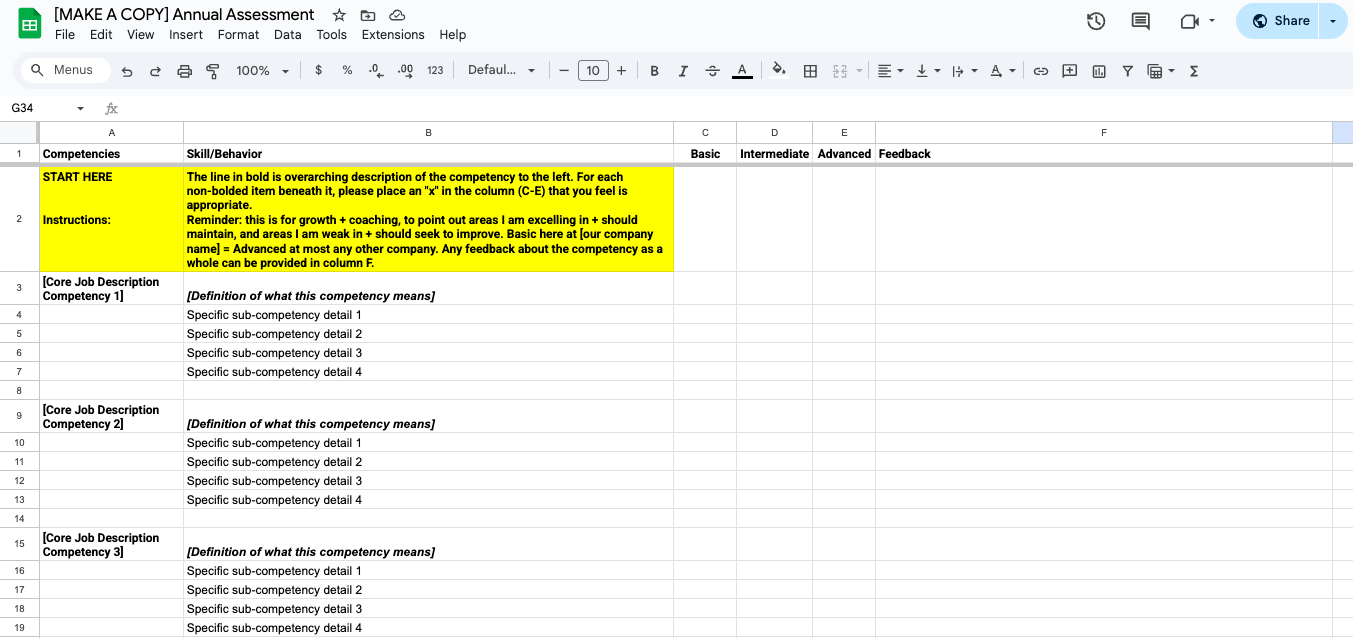
You can use it TODAY. It has four sections:
Core job description competencies
3-5 items based on what you’re actually accountable forCore company trait competencies
3-5 items based on your company values + how you need to operateCore strength/weakness competencies
3-5 items you’re excelling at + 3-5 areas you need to developGrowth + reflection
Retrospective on the past few quarters + some forward-looking goals to document and align on
For each competency, you fill in the definition, then break down 4 specific sub-items. Then you define what Basic/Intermediate/Advanced looks like.
It takes 1-2 hours to fill out. That’s it.
Access the template here: (don’t worry, it’s free) https://docs.google.com/spreadsheets/d/1EaK4OarYZPOSHesvvnsIye3RdV-HxDuqlXOz2nBHT5A/edit?usp=sharing
Fill in the placeholders. Make it specific to your role. Make it specific to your company. Make it specific to you.
Then give it to your manager and say: “I built this custom assessment because I think it’ll be more helpful for both of us. I’d like to use this for my review.”
Your manager will be impressed. They’re going to see that you’re taking ownership of your own growth. They’re going to have something actually useful to work with. And they’re going to put that much more thought + feedback into it knowing how important + valuable it is to you.
TL;DR (even though you did read all the way to this point)
Annual review season doesn’t have to suck. It doesn’t have to be a checkbox compliance exercise. It doesn’t have to be a vague conversation about generic competencies.
It can be a growth tool, but only if you’re willing to take ownership of it.
Generic assessments are a waste of everyone’s time. They’re vague. They’re opinion-based. They don’t provide direction on how to actually improve.
Custom assessments are specific. They’re measurable. They drive growth.
Custom assessments take a little more time up front to build out, but the ensuing conversation + path laid out are worth 100x the hours spent creating it.
So this week, don’t wait for your manager to send you a stock assessment template. Go build your own + get specific with it. Then give it to your manager.
Your future self will thank you.
Book quote of the week
“And if I’ve faied, it’s no one’s fault but mine. Because I didn’t pay attention to what they told me - to what they taught me, practically, step by step.”
- Meditations, by Marcus Aurelius
See you next Saturday,
Sam