


Two months into the fractional world + it’s been interesting to see what prospects and clients
Think they need help with
Actually need help with
I’ve been talking with everyone from founders + CEOs to marketing leaders + practitioners. Most of them come into conversations looking for their next growth lever, wanting to get an ABM strategy in place, trying to figure out how to scale media spend, etc., assuming that what they need is additive to their current plans.
But after going through discovery with them and/or taking a peek under the hood inside their systems, I usually find there’s a good bit of foundational work that, if executed, can help hit growth goals without needing to 2x their media budget, hiring a bunch of BDRs, or any other crazy silver bullet that’s trending on Twitter this week.
So today I’m taking inspiration from my friend Paul Stansik + his growth checklist and am sharing the b2b demand gen checklist that I use when assessing + taking on clients in my work. It has 4 sections that I strongly recommend be followed in order. Today is part 1 and will cover the first section + over the next weeks, I’ll be back to cover the final 3. If you can’t handle the suspense of a full month series, here’s a link to the full checklist.
ALSO - make sure you read all the way to the end as I have something new, free, and valuable (I think David Ogilvy would be proud seeing those 3 words used here 😂) that you won’t want to miss…
Sponsor: Primer
Outbound is broken + LinkedIn somehow keeps getting more expensive. Now what?
Every B2B marketer is paying premium prices for the same shrinking pool of attention on the same two channels (LinkedIn + Google).
Meanwhile, channels like Meta, YouTube, + display cost a fraction of LinkedIn…but most B2B teams can’t use them. Standard account lists match at 15%, AKA audiences are too small to learn + too noisy to convert.
Primer fixes the match rate problem. They turn your ICP, target accounts, and net-new prospects into 45-85% matched audiences across every major ad platform. Now the efficient channels we couldn’t use before due to low match rates are suddenly usable.
Get started with a free account + 30-day trial of paid plans today!
Fun fact: Rippling credits them for their $145M Series B success.
Section 1: Business fundamentals + health
"A house built on a shaky foundation will eventually crumble."
Before touching any existing demand programs or looking into what else we should add, there are 7 core things that I look at to understand what kind of mess I’m walking into where our opportunities lie. What we’re ultimately doing here is making sure the business is ready and able to support more demand before we drive more in.
1) Confirm product/market fit
This one should be obvious, but you know what they say about assuming…
TLDR: verify that customers in their ICP buy, stay, + bring others along (AKA word of mouth) without needing any kind of miracles from sales, marketing, or customer success.
Why it matters: demand generation amplifies whatever already exists. With real fit, more spend produces more good customers. Without it, the same spend produces more churn and wasted pipeline.
What good looks like:
Retention by cohort: logo + revenue retention for recent cohorts, split by ICP/non-ICP, make sure it holds up/improves
Win rate and sales cycle length: better inside the ICP than outside it + stable/improving over time
Customer disappointment test: ask customers with real usage how they would feel if the product disappeared. The benchmark is 40% or more answering “very disappointed” (Sean Ellis survey)
Current mix of what’s “pulling” in customers: does a significant share of pipeline come from referral, inbound, word of mouth, etc.?
Describability: can last 10-20 wins be described in the same terms (pain, trigger, buyer, outcome sought, etc.)? If each win has a different story, fit isn’t found yet.
2) Run a revenue performance audit
TLDR: reviewing the funnel end to end (think: Google Search Console impressions or GA4 Website visits through CRM Closed Won) + compare it to their industry benchmarks. Almost every time, there’s some type of constraint holding revenue back. If they have multiple product lines or verticals, run those individually if they behave differently or are held to separate goals.
Why it matters: this will tell us what to fund, fix, or stop as it all depends on where their funnel actually breaks.
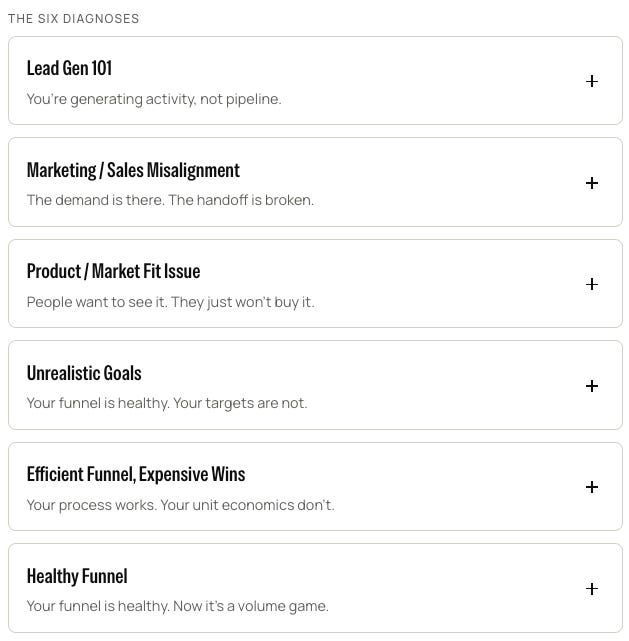
What good looks like: after the audit, you can name the specific constraint in one sentence + know which one metric proves it. Most funnels land in 1 of 6 diagnoses:
3) Confirm ICP definition
TLDR: a written ICP (ideal customer profile) that sales, CS, AND marketing all share. Usually includes a mix of firmographics, demographics, technographics, the pain/outcome sought that triggers a purchase, the buying group members.
Pro-tip: build an anti-ICP alongside this. Gives a LOT of clarity and you’ll often find things in here that you use to fine-tune the ICP.
Why it matters: targeting, messaging, offers, content, etc. all start from the ICP. If internal teams have different definitions, marketing’s leads won’t be qualified by sales, sales’s deals won’t be retained by customer success, customer success’s recommendations for product won’t be acted upon, etc.
What good looks like:
A written definition exists
Sales, marketing, + CS each independently align on the same criteria for fit/not a fit
Not to take the thunder from #4 below, but after reviewing the last 10-20 closed won accounts, the majority of them match the written definition
4) Run a win/loss analysis
TLDR: a structured, unbiased review of closed (you guessed it, won AND lost) deals. Bonus points if you can include data from buyer conversations where possible (call recordings, etc.), covering why they did/didn’t buy.
Why it matters: it tells us what buyers value, it feeds the product/market fit feedback loop, helps to refine ICP, and also helps you spot channels/depts/vertical weaknesses.
What good looks like: clear takeaways based on pattern(s) seen across the deals reviewed. Usually broken out into 2 types of buckets:
Product/offer related: pricing, missing features, competition, timing, etc.
AE/vertical discrepancies: do we win/lose significantly more in certain verticals? Are there outliers (good/bad) by win rate across AEs? By sales manager?
5) Define a tier 1 account list
TLDR: a list of 25-250 named accounts inside your CRM that we can track the progress of over time.
Why it matters: these are examples of your ICP list in practice. If they are truly the best fit, by naming these + putting a plan toward them, we should be able to see meaningful progress in gaining their business over a defined time period. If we aren’t able to, that points to issues with product/market fit and/or ICP definition.
What a good list looks like:
True tier 1 fits only - no wishlist names or Fortune 500 vanity logos (unless that truly is your market)
These should be the “easiest” accounts to win + retain at the highest rates long term
Every account is 1) inside the CRM and 2) tagged as tier 1 so you can track progress against the list (e.g. unaware > aware > engaged > considering > negotiating > customer > advocate)
6) Do deep customer research
TLDR: research on the people who buy + use the product: what specifically they do, how do they describe their role to others, what do they struggle with day-to-day, what outcomes are they held to, what content they like, where do they spend time, what podcasts do they listen to, what resources do they learn from, etc.
Why it matters: messaging, offers, channel plans, content, events, etc. can should all be built around the above. This is the definition of marketing.
What good looks like: documents for markets + personas are built from this evidence and is in a shared location for anyone in the company to pull up + reference
7) Run a stop-doing audit
TLDR: this is a list of every current program, channel, campaign, etc. that’s sorted into one of three groups: stop, scale, continue. After steps 1-6 above, between your findings + talking to the team, everyone should have a good sense for this list + it helps to ensure all are on the same page before proceeding to section #2.
Why it matters: this will help free up time + money before adding anything new. There’s usually a good bit of work being done on things because “they’ve always been done,” but in reality are minimally/no longer effective.
What good looks like:
Scale
Helps fix the biggest constraint found in the revenue performance assessment. Keep doing it (and probably more of it).
Continue
Reaches the ICP but doesn’t necessarily help fix the constraint. Keep doing it at low effort, but I wouldn’t put the next dollar or hour here.
Stop
Neither of the above, so that makes the answer here simple: cut it
SNEAK PEEK: Marketing Meditations podcast

I’ve spent over 17 years in marketing. Over the past couple of years I kept finding that much of what I was learning had been learned + written down decades earlier.
So over the past handful of months, I’ve been re-reading some of the timeless marketing classics (Confessions of an Advertising Man by David Ogilvy, Scientific Advertising by Claude Hopkins, etc.), as well as reading others for the first time.
And after reading through these, I’ve taken inspiration from David Senra’s Founders podcast + decided to do something similar, but for marketers like myself.
Every episode, I pull one idea from a classic marketing text (Hopkins, Ogilvy, etc. - AKA the ones still worth stealing from) and translate it into something you can use in your work today. A single book can supply several episodes, so the book stays as the source and each episode covers one concept from it.
This show is where I go back to those sources, pull out the core ideas, and look at how they apply today. It forces me to not just read the book once, but to read it again as I review my highlights, and then a third time as I organize those into a way that I can speak to on the podcast, and then a fourth time as I actually record the episode, and then a fifth time as I do the post-production editing before pushing it out into the world.
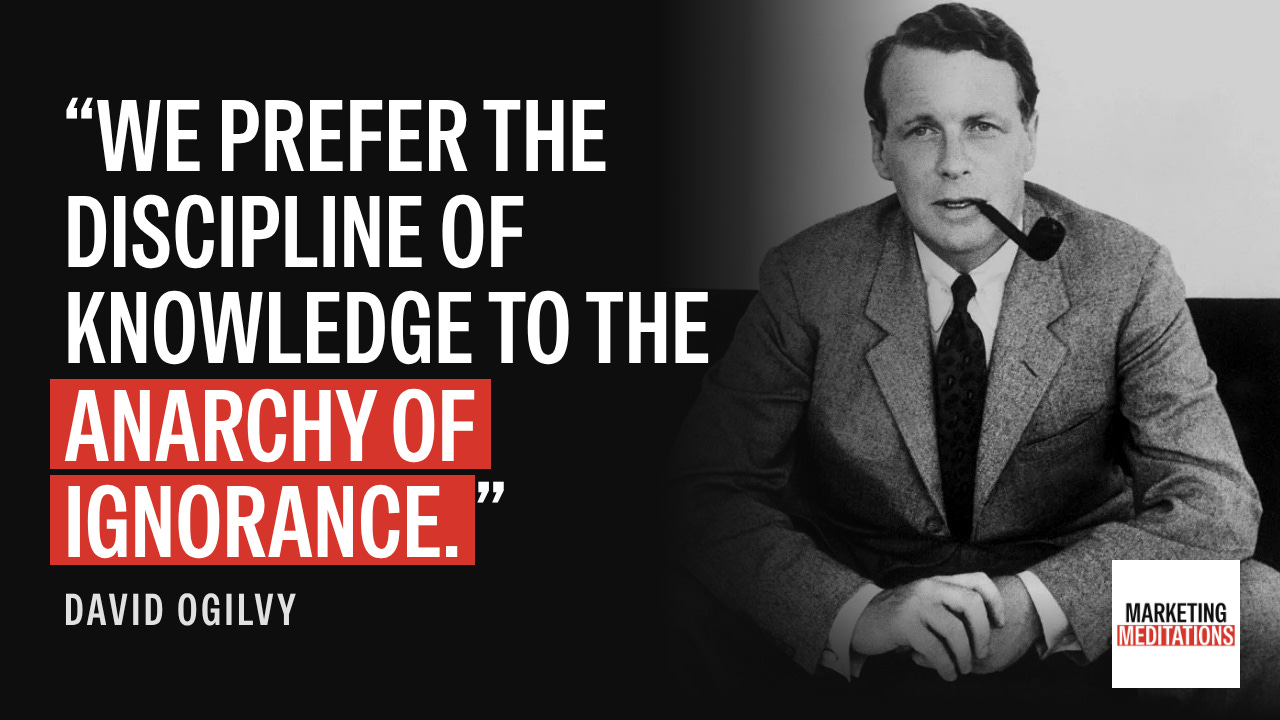
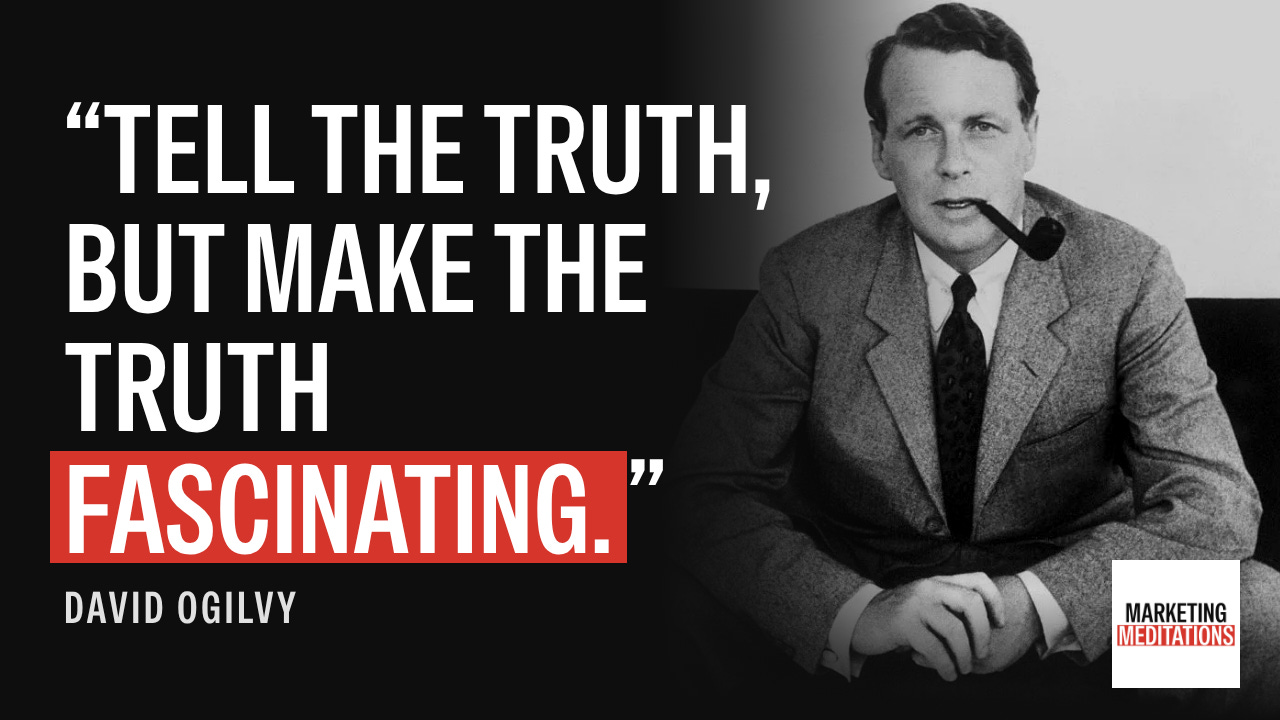
As readers of this newsletter, I wanted to share this with you all first as a small thank you for coming along on this ride with me. The first two episodes are live + in them I covered 2 principles/learnings from Confessions of an Advertising Man by David Ogilvy.
Listen on Spotify
Listen on Apple Podcasts
Watch/listen on YouTube
If you like what you hear, it’d mean the world to me if you subscribed to it wherever you listen, give it 5 stars, and/or share it with a marketing friend.
And if you don’t like it, or think I could do something better with the episodes, reply back to this email letting me know - replies come directly to my personal inbox so I promise I’ll see it.
See you next week,
Sam