


We got stuck in analysis paralysis this week.
Not because we didn’t have enough information, we had plenty. The problem was in some instances I was starting to blur the line between “I need more info to make this decision” and “I’m seeking additional info to confirm my decision” (aka confirmation bias).
This showed up in 3 places: evaluating different vendor sets for 2 different use cases we needed software for on our marketing team + deciding on the AEO approach we’re going to be executing this year.
Unfortunately, this is a trap I see regularly - we get stuck in research mode, gathering data, talking to more vendors, reading more reviews, talking to peers, + waiting for 100% confidence before we move.
So I reflected back on this week + what I had us do to break out of this cycle.
Sponsor: HockeyStack
For the past 2 years I've been asking myself the same question over + over again:
"What does an ideal GTM ecosystem journey actually look like for our ICP?"
...but I still don't have a *clear* answer
I know the answer exists + that it's hiding in our data. I know that if I could actually see it, I could craft our GTM execution around it instead of guessing. But every time I try to piece it together, I get stuck at the same point:
"Are BDRs more successful if they've seen ads first?"
"Do the order of activities impact one another?"
So we're all sitting here with tons of unstructured data that could answer these questions, but don't have the infrastructure to actually surface the answers we're after…until now.
HockeyStack launched Blueprints recently + it's the first tool I've seen that finally shows which activities + sequences actually happen when we WIN and what is (or isn't) happening when we LOSE.
From strategy > execution
We’ve been mapping out our approach to SEO/AEO content for weeks. And I’ve been feeling the paralysis creeping in - there were always more questions, more nuances to explore, more data needed to understand what direction to go, etc.

The trap here is that strategy work feels productive. We’re thinking, we’re planning, we’re gathering more context, we’re making data-informed decisions, and so on + so forth. But eventually, we’ve got enough to be confident in the direction we need to move in, so the “we just need one more week of planning” becomes procrastination disguised as diligence if we’re being 100% honest with ourselves
So I set a hard deadline: “By [date], we’re moving from strategy + planning to execution.”
That deadline wasn’t arbitrary or an ASAP date - there was plenty of time between when I set it + when it arrived (aka enough time to prioritize any remaining details we needed). But it forced us to answer the real question: “do we have what we need to start?” And the answer to that was yes.
Now we knew what to do in the time between when we set that date + the “start executing” date. We stopped researching + started planning the execution.
What are the macro tasks?
What subtasks roll into those?
What sequence does this need to occur in?
We knew what we needed to do. Now it was just a matter of mapping it all out so that it would happen.
We all know that we need to know our DIRECTION first. What we’re trying to accomplish, what success looks like, etc. But one thing I’ve learned over the years is that knowing your direction means NOTHING without VELOCITY behind it. Velocity is the action. It’s taking the first step + making progress toward the plan we created.
For years I got this backwards. I’d think, “I need to know everything before I move.” But what I’ve realized is that it’s, “I need to know the direction, then I need to move, then I can adjust based on what I learn.”
It’s understanding that we’re not locking in the “final” strategy + it being dogma after that. We’re simply locking in v1 so we can finally take off. Then once we’re in motion + have velocity, we’ll have real data to adjust our direction with. Data we can’t get from spreadsheets or another round of research.
Evaluating vendors
Unfortunately, vendor decisions are a little different from the above. We can’t just “take off” with a tool and adjust - we need to actually choose one.
This is where analysis paralysis gets tricky. We talk to one vendor, have questions, so we then talk to another to compare. Now we’re seeing the differences between them, so we dig deeper. Before we know it, we’ve spent 3 weeks evaluating, have a list of 10+ vendors, then somehow come across yet another one that we need to look at before we move forward in conversations with any of the others.
So here’s what we did this week to stop this cycle: created a scorecard.
One of the tools we need is something to help with gathering AEO/LLM data. So I tasked our organic growth manager to list out the things that actually mattered in making this decision. And he then came back with things like:
Prompt coverage
Prompt volume + precision
Quality of answers + how recent the information is
Topic clustering capability
LLM coverage
Sales rep helpfulness/trustworthiness
Quality of team (CS to engineers)
Post-sale support/customer success
Pricing
Third-party reviews
Peer recommendations
We didn’t overthink the criteria - these came directly from what we actually needed to do the job well + to then validate which we were leaning toward. Then it simply became an exercise in scoring each vendor. Some items were on a 1-5 scale, some were binary yes/no responses, some were open-text responses.
Then the magic happened. Once he filled out that scorecard, the decision became obvious to us. One vendor clearly won. It wasn’t perfect in every category, but relative to the others, it had the right combination of what was most important to us.
Pre-scorecard, we could’ve kept researching forever. Post-scorecard, we had the answer.
Two-way doors > one-way doors
My CEO taught me this one + it changed how I think about committing to decisions:
When we’re about to commit to something (a tool, vendor, strategy, etc.), you need to make sure it’s a door you can walk back out of if it isn’t working.
For vendors, that might mean starting with a M2M contract instead of 12/24 month commitments. Or building in an explicit opt-out clause after 90 days if some pre-defined result or milestone hasn’t been met.
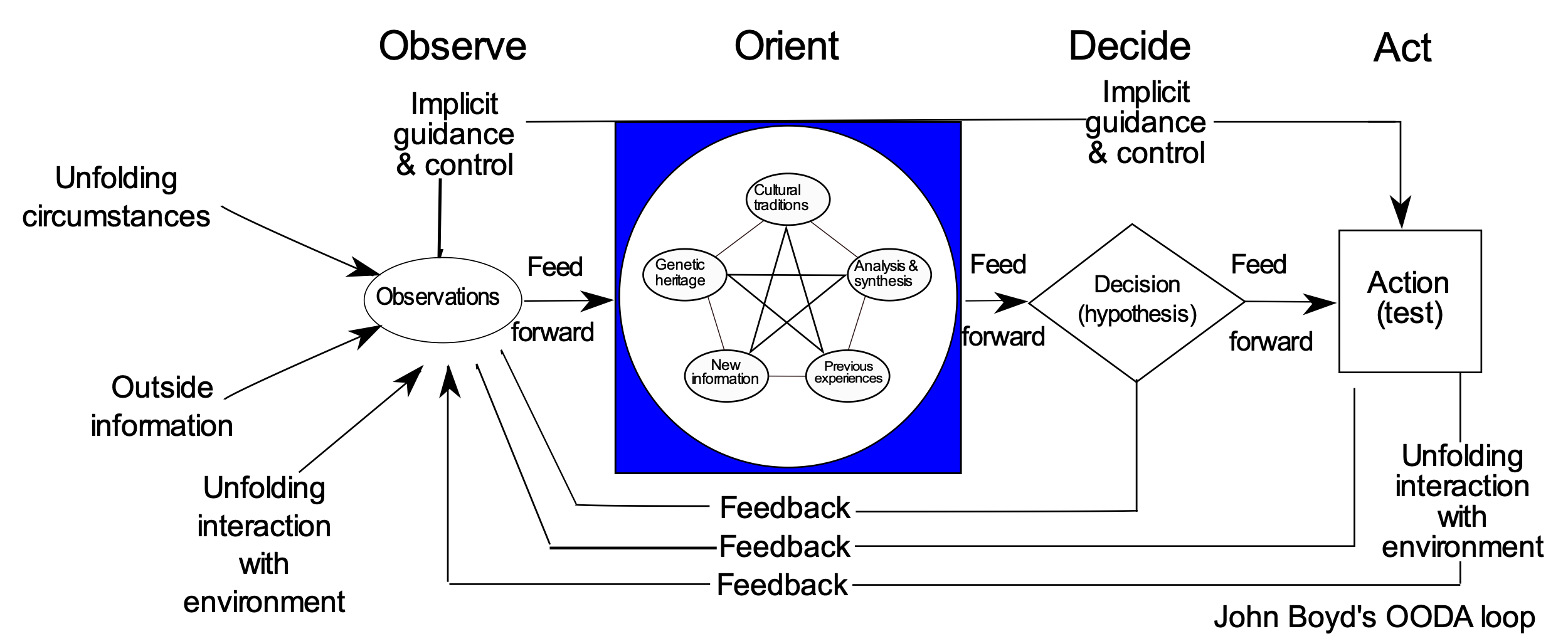
For strategies, it means viewing things as iterations. Or as John Boyd, the subject of one of my all-time favorite biographies, defined - we apply the OODA loop methodology. Observe, orient, decide, and act. We execute, we see what happens, we adjust.
But here’s the part that matters - this has to be communicated explicitly when making the decision. “Here’s what we’re doing + why. Then here’s how/when we’ll adjust or exit if it’s not working.”
That explicit statement changes how people perceive your decision-making. We’re not recklessly committing or being stubborn in sticking to “the plan” as it’s written. We’re making the most informed decision possible as time goes on + new data/insights surface.
Once your leader sees how you go about this process a few times, trust builds with them. Eventually we don’t need to say it out loud anymore as it becomes implicit, but we have to earn that by being explicit first.
The cost of waiting
Analysis paralysis feels safe as we feel like we’re being thoughtful + methodical. That we’re gathering info + being thorough. But the’re a cost to this - time spent not making progress toward the outcome we seek. And in a year where I have one goal - exceeding our revenue target - I don’t have time to be paralyzed.
The scorecard + the time constraint solved that for us this week. They aren’t perfect decision-making frameworks, but they forced me to recognize when we had enough information + to move forward with it.
They forced me to shift my thinking. To stop asking “do we have enough info?” and start asking “do we have enough info to move confidently?” Two very different questions, but one can keep us paralyzed forever while the second gets us moving.
Book quote of the week
Since I brought up John Boyd earlier, it was only fitting to have something from his biography this week:
“Whoever can handle the quickest rate of change is the one who survives.”
- Boyd: The FIghter Pilot Who Changed the Art of War, by Robert Coram
See you next Saturday,
Sam