


Early in my career I noticed something interesting as I’d sit in on large departmental meetings.
95% of the meeting was filled with talking from individuals who didn’t seem to have any real point to make, but felt the need to speak frequently so their voice was heard.
And then there was 5% of the meeting where, when 1 or 2 specific people spoke, everyone shut up and hyperfocused on what they had to say.
I learned three lessons when that realization finally hit me:
Sponsor: ALVA Studio
Picture this—a founder who just closed a $2M seed round. The product works, the team's sharp, the investors are in. Then a prospect pulls up the website and it looks like every other "AI platform for modern teams" that crossed their screen that week.
The team's heads-down on the roadmap, sales is chasing pipeline, and no one catches that the brand is making every conversation start from a half-step behind.
That's the thing about brand—it's never the fire you're putting out today. Until it's the reason a deal, a round, or a candidate went to the company that simply looked more real.
ALVA Studio built the fix for exactly this: a 4-week Brand Sprint that takes a funded B2B SaaS or AI company from interchangeable to inevitable. Senior team, direct line to the people doing the work, no six-month agency runway. Companies like Loxo, Accord and AceLab all saw jumps in conversion, brand credibility and analyst recognition post-launch. This is the natural next move once the product has outgrown the story around it.
Lesson 1: Don’t be one of the 95% that speaks just to speak
I’m sure you immediately had a flashback to a previous job, a recent meeting, or even a few specific individuals when you read this. The person who needed to get to the point already. The person who seemed to take the classic improv advice of “yes, and…” too literally and was chiming in after every point someone else made. The person who, when starting to speak, you could see eyes in the room starting to roll.
The interesting dynamic at play is that, unless you’re in a small, discussion-oriented meeting, there’s often an inverse relationship between the amount someone speaks and how engaged the room is when they speak. Individuals in the 95% are the ones on the far right of this graph - lots of talking, few engaged listeners.
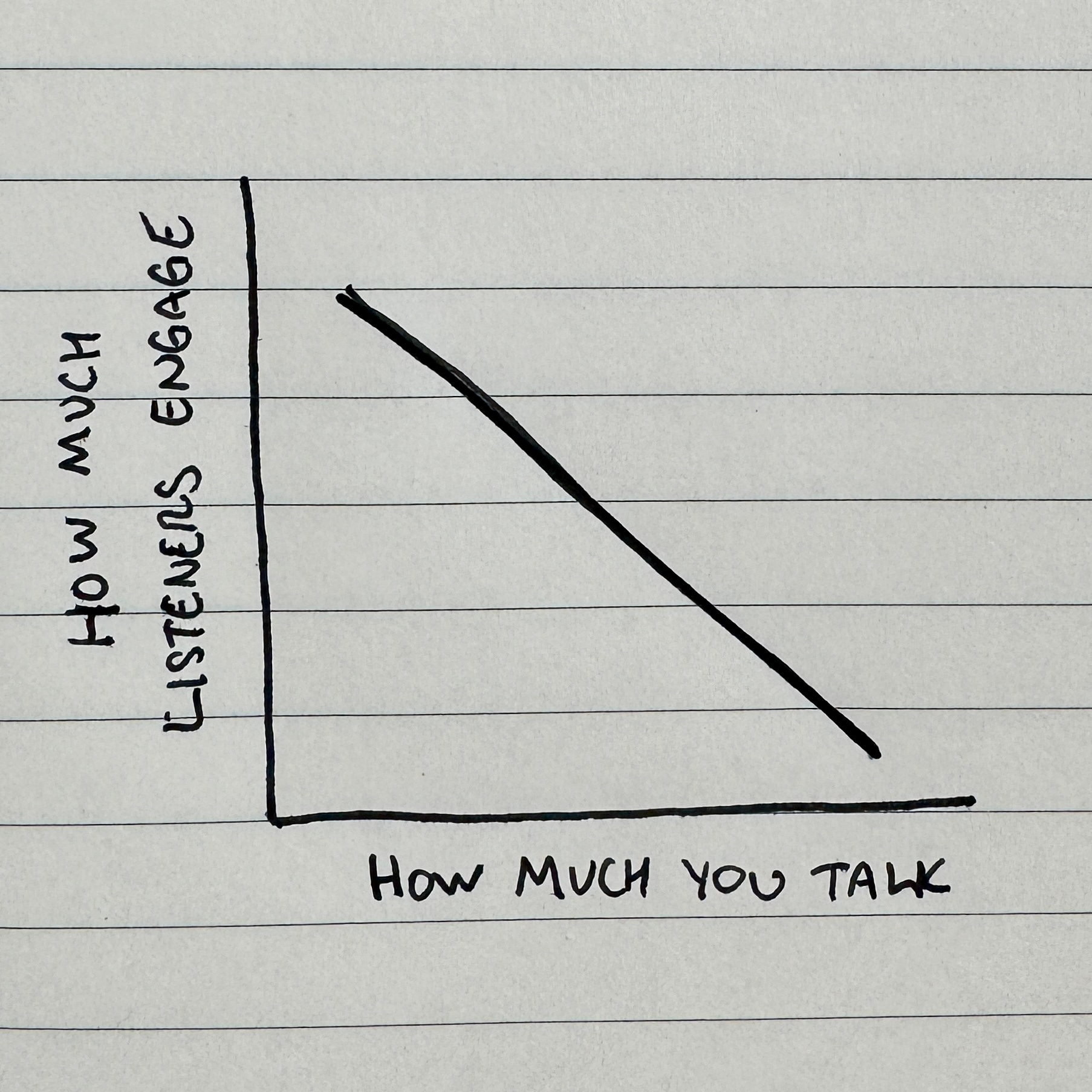
People subconsciously categorize others into buckets around this. There’s a reason those eyes start rolling after just two words. That person could finally be about to say something profound, but they’ve trained people that when they do speak, they usually don’t say anything profound or valuable.
And for those getting started in their careers, or those who are finally getting a seat at “the table,” speaking more runs the risk of saying something foolish that has others wondering why you’re in the room to begin with.
Lesson 2: When you speak less, more listen
Let’s have your memory flashback again to a previous job or recent meeting you’ve been in. Now think about the opposite of the above. Was there an individual in the room that, when they said something, you found yourself nodding along or thinking, “Wow, that’s a really [great point/interesting insight/good idea]!”
That type of commentary often comes from someone who’s been sitting back, absorbing the overall conversation, reading the room to see who is (and isn’t) in there, and is able to wade through everything so that when they have something to share, it’s highly relevant to the conversation.
This is the flipside of what the others do. And that is why these people are on the left side of the graph below - less time talking, but when they do they have everyone engaged with what they’re saying.
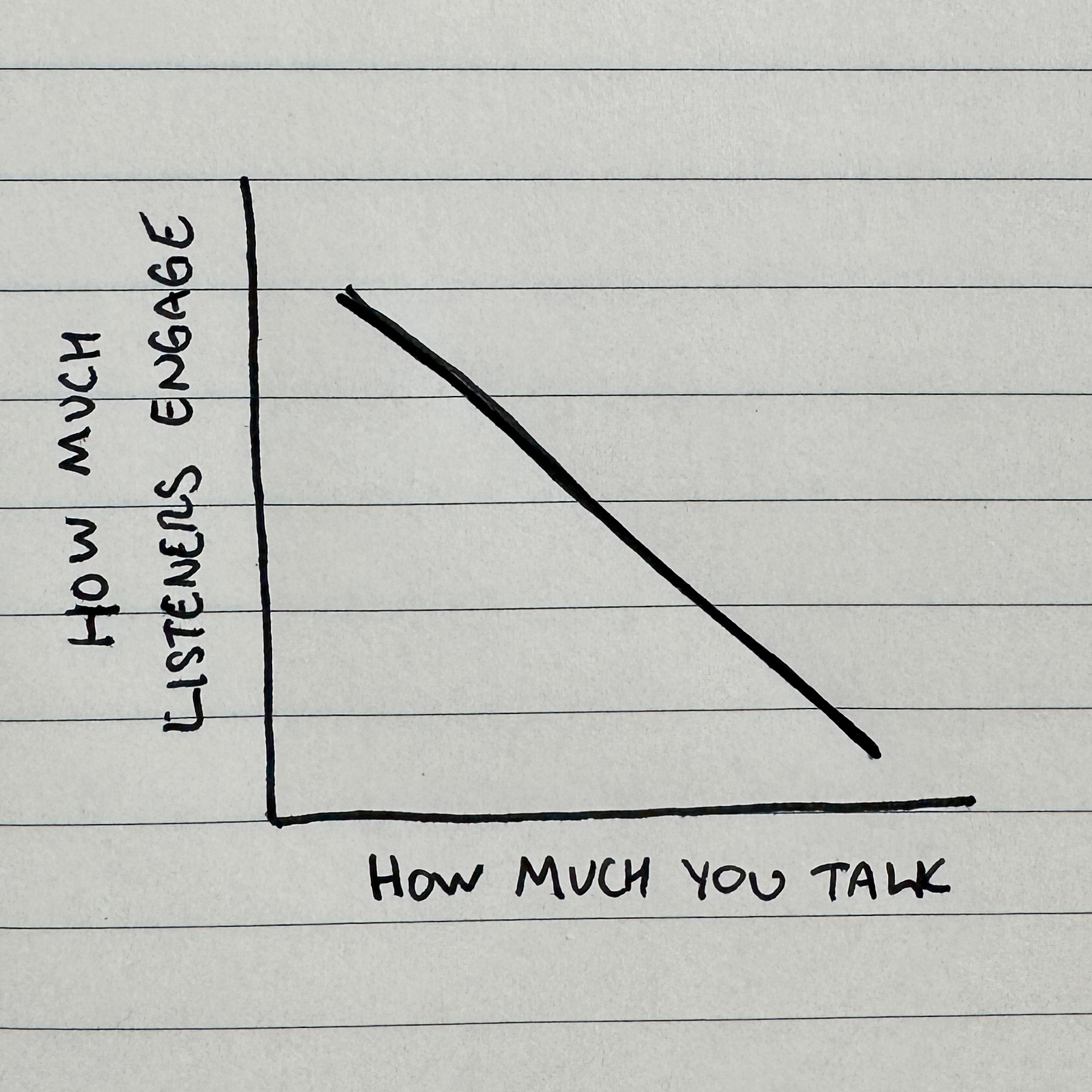
For those getting started in their careers, or those who are finally getting a seat at “the table,” saying fewer, but highly relevant, things solidifies anyone who doubts why you were hired or why you’re now at the table. The person who brought you on saw something in you that they now see. It also lends more weight to the items you share, so when people leave the room, they aren’t thinking about the 100 irrelevant things that one team member said, but are thinking about that 1 incredible point/idea you shared.
Lesson 3: This concept applies equally to your content strategy
There is a LOT of content out there. And to be honest, a lot of it is just noise.
It’s not a new idea.
It’s the same thing everyone else is saying.
It’s the thing that brought a spotlight on you/your company years ago, but is no longer relevant or novel.
It looks (content medium) exactly like everything else out there.
It doesn’t spur any further thinking from the recipient.
It’s consumed and the end user thinks, “Well, that’s 3 minutes of my life I’ll never get back.”
It’s the content equivalent of the person earlier who would speak just to hear their own voice.
I was re-introduced to Jay Acunzo’s content lately and I’m so glad I was as it helped me solidify this lesson. He has a strong POV on content, more specifically, a strong dislike of commodity content. He was able to map out a brilliant simplification for what this looks like in the B2B space.

Sam, what’s your point?
I saw a post on LinkedIn from an individual with a very large following. They were sharing advice about if they were to start over on LinkedIn, how they would do it. And then they shared this step, to which I nearly wanted to pick up my computer and smash it on the ground:
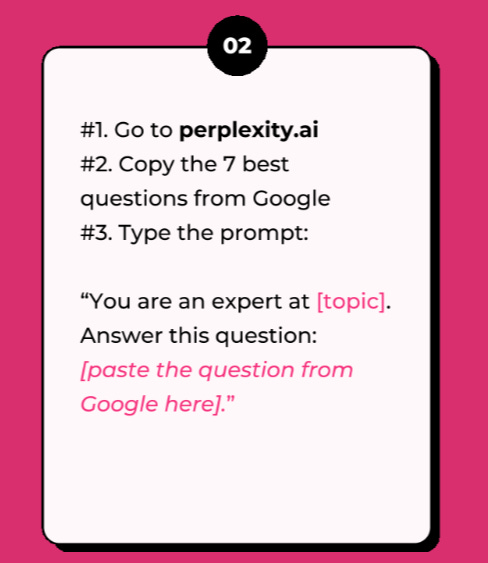
This is the antithesis of everything I’ve said so far in this newsletter. This is exactly what would have you living in the commodity cage that Jay outlined above. And unfortunately, this is what the majority of people are probably going to be doing over the coming years.
Using AI as the subject matter expert, not yourself
Using AI to write the content for you, sounding nothing like you
And then pumping out these content pieces daily, if not multiple times per day
This is the definition of how to become a false thought leader. This is exactly how to get people NOT to listen to you. This is the social version of the person who speaks just to hear their own voice.
Little expertise in the space you’re creating content about.
And not even writing in your own words or using the lessons you’ve learned in the content you’re producing.
Whether you’re creating content for your personal brand or for your company, this perfectly translates to both cases.
You can be the signal, or you can be part of the noise. You get to decide.
See you next Saturday,
Sam
P.S. know a marketer who’d enjoy these newsletters as well? Reply back to this email (so I get it) + cc them on it. As a small thank you, I’d be happy to help answer any questions you have or hop on a call some time for a fun marketing session :)