


This year I’ve been staring at a daunting ambitious growth goal for us at Loxo. It isn’t unrealistic by any means, but it’s also not a number that we’ll be able to just stumble into. And while I’m a demand gen marketer at heart, I recognize that I can’t keep pouring ad dollars in at the top as time goes on in order to hit these goals.
So this has been the “what’s keeping you up at night?” question for me since we kicked off 2026 back in January. How do I figure out the best way for us to continue to grow without defaulting to the “more” bucket (more ad dollars, more email sends, more webinars, etc.)?
And after taking a step back a few weeks ago to look at the big picture, I have my answer.
Sponsor: YOYABA
AI agents hate your website. And they don’t care about your SEO rankings.
As AI agents increasingly navigate the web and execute tasks on behalf of users, your site needs to work for machines, not just humans. Problem is, if you open LinkedIn right now, you’ll see a new “AI agent strategy” every day. Most of it is clickbait fluff with zero actionable substance.
On May 7th, Oliver Kuttruff (Senior SEO Consultant at YOYABA) and Crystal Carter (Head of AI Search & SEO Communications at Wix) are breaking down what an agent-ready website actually looks like in practice:
What WebMCP is, what it isn’t, and how to pick between Declarative and Imperative API approaches
Which strategies are production-ready today and which “hacks” you can safely ignore
How SEO is shifting from ranking pages to enabling agent actions
If you’re overwhelmed by the AI agent noise and want clarity on what’s actually worth implementing, you won’t want to miss this. May 7th, 2026 from 9:30-11a EST / 2:30-4p BST.
Like (marketing) moths drawn to the (sexy) flame
I’m going to be honest, when I realized what our biggest constraint was, I laughed out loud because of how “simple” it was. The issue was we marketers loveee us some complexity. The really deep, sophisticated, insightful finds that help us justify our existence to the company + marketing team. The ones that have leadership saying things like, “Can you believe Jenny uncovered that huge finding for us! WHAT a great hire she was!”
Whether we like to admit it or not, we marketers love those little ego dopamine hits as those are our equivalent of hitting quota that Sales has or shipping that new product/feature that Engineering has. So we reinforce that pattern by doing more “work” that gets that type of recognition.
But the downside of it is that we FLY past some of the most obvious things staring us in the face that have the most leverage. They aren’t sexy enough. Or we simply assume that they’re working just fine already and we don’t bother to examine them closely.
So as I’ve been looking at our 2026 goal + what we can do to get there, I wanted to put everything in front of myself to understand the “global” marketing system at play. We’ve been optimizing for local maximums in LinkedIn Ads, PLG email nurture sequences, etc. ad nauseam, and while we should absolutely continue to do so, I need to optimize our global maximum. And this meant taking a step back + getting all of the obvious/”simple” data front + center.
The data
Nothing crazy here. Grabbed the following 12 datapoints from the past 2 years of data + YTD so far, then put them in “sequenced” order relative to the funnel.
Variable marketing spend (ad spend, event costs, etc.)
Fully loaded marketing spend (variable spend above + all marketing overhead)
Brand impressions (Google Search Console, Profound, etc.)
Website visits (Google Analytics)
Demo requests (Hubspot, Salesforce, etc.)
Meetings booked (Hubspot, Salesforce, etc.)
Discovery attended (Hubspot, Salesforce, etc.)
Sales qualified opportunities created (Hubspot, Salesforce, etc.)
SQO pipeline value created (Hubspot, Salesforce, etc.)
Late-stage opportunities (Hubspot, Salesforce, etc.)
Closed won deals (Hubspot, Salesforce, etc.)
New revenue generated (Hubspot, Salesforce, etc.)
Once I had all of the above, I could quickly see how our global system was performing currently, quarter over quarter, and then compared to industry benchmarks for our go-to-market motion + market we sell to.
While it’s easy to see our own quarterly trends + to think “things are maintaining or slightly deviating from normal” and be ok with that is easy to be lulled into. That’s why I like to pull in industry benchmarks to see if my “normal” is actually better, worse, or on par with what’s expected. (note: yes, every company has its own nuances and benchmarks are “averages” BUT for something like this, we’re looking for directional data, not data that should be taken as dogmatic)
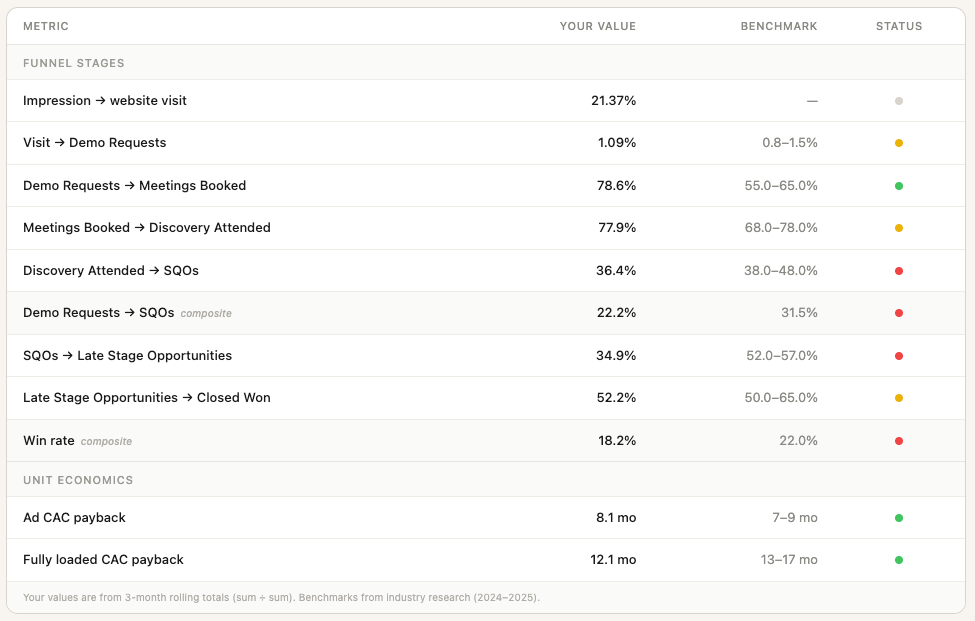
Once I laid out all of that data and put in calculations for conversion rates between stages, cost pers, etc., that’s where the obviousness of the constraint I need to focus on became apparent. Here’s an example of the output using dummy data to give you a sense for how I visualized this:
The most obvious constraint
In the above example, there’s a fair bit of yellow/red for performance relative to benchmarks. When I was looking at my data here at Loxo, our “sales” funnel is pretty healthy, lots of green, so the most obvious constraint jumped out at me for two reasons:
It was the only “red” one, telling me I was 10%+ off industry benchmarks
It was the one area I haven’t put any resources toward during my 3+ years here at Loxo with real intentionality
So what is this “mysterious” yet super obvious constraint that I’m now smacking myself in the back of the head for not realizing sooner? Our visit → demo requests conversion rate.
And why do I secretly love that this is our biggest constraint right now?
As mentioned a moment ago, we haven’t done much of anything here in a methodical way, so we have the full range of website conversion rate optimization plays at our disposal to start running through
There is SO MUCH LEVERAGE at this constraint. With this being so “high” in our funnel, if we were to take the rate from 1.0% to 1.5%, that then improves every single number below it. Here’s how that would play out in an example model:
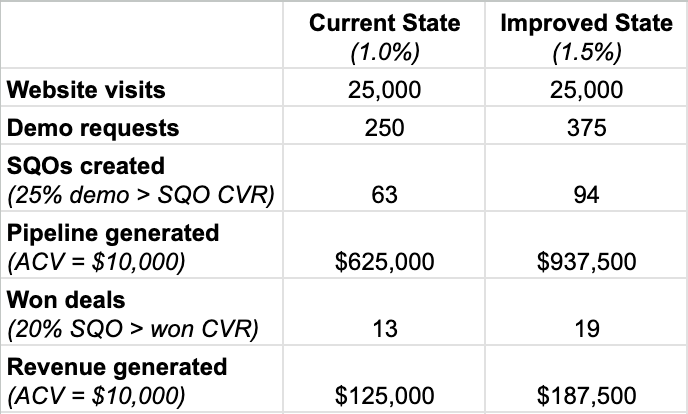
Crazy right? Going from a “small” 1% to a 1.5% conversion rate in getting visitors to go to the demo request page (50% increase overall), cascades that 50% down through the rest of the funnel.
50% more demo requests
50% more SQOs created
50% more qualified pipeline
50% more deals won
50% more revenue generated

^^ me, geeking/nerding out at the upside of this kind of opportunity.
Think about it, where else can you get this type of leverage? Certainly not from adding a couple thousand more ad dollars to a campaign or hiring a few more BDRs.
All of this because I zoomed out to look at the big picture + think from a boring systems lens instead of a “sexy” channel lens.
This is what the theory of constraints is really about. It’s finding the one constraint that, when removed, cascades improvement through the entire system. It might not be the sexiest one or the most sophisticated thing in the world, but it’s the one with the most leverage. We’re quick to be seduced by complexity because it “feels” like mastery + as mentioned earlier, any chance to flaunt those “master-level” skills, we’re quick to jump at. But real mastery is seeing the lever with the highest upside for opportunity behind it, sexy or simple.
Here's one thing I'm curious about - what's your “yellow” or “red” rate? Where’s your biggest opportunity to apply leverage toward that? If you’re like me, it may be the one you've been flying past because it doesn't feel sophisticated enough to spend time on, but is well worth digging into.
Book quote of the week
“Be a maker who makes something interesting people want. Show your craft, practice your craft, and the right people will eventually find you.”
- The Almanack of Naval Ravikant, by Eric Jorgenson
See you next Saturday,
Sam
Let's play a game of "have you ever"
Have you ever....
Looked at the visitors to demo request through the lens of identified vs anonymous?
Looked at the visitors to demo request through the lens of opt-in vs inferred identification?
It's not just a game of MORE, it's a game of BETTER or at least meeting the minimum performance of a good user.
Some will say acquiring users who churn is not useful. Depends on the CAC and to be honest, no business ever says "I wish I did not get the cash from those guys who stopped using us"
It comes down to quality. Is the vanity metric the NUMBER increase or the NUMBER increase in higher quality customers.
In a PLG motion, you can keep that CAC under control. In an ABM motion, much harder to contain.
I remain insanely curious about pursing best customers through PLG vs ABM because I 100% know the ABM costs 10x the PLG when acquiring them.