


Last week I was talking to a new client who needed to 3x their meetings booked from Q3 in order to hit their new Q4 goal for a specific segment.
When letting me know about this Q4 goal, the first thing they asked me was, “please come up with a media plan to help us achieve this. We need to present it to leadership later this week.”
Scaling paid media is my specialty, so this type of request isn’t an uncommon one (I strangely love this kind of stuff - it’s a puzzle to solve for how to hit new growth targets efficiently 🤓).
But here’s the curveball you probably weren’t expecting: the plan I presented to them 2 days later had ZERO increase in paid media spend AND was set to not only help them drive 3x more meetings booked, but actually 4-5x it.
Crazy talk, right???? I would’ve thought so as well had I not been stopped in my tracks after doing a quick audit of their funnel before telling them how much to spend.
Sponsor: Primer
Outbound is broken + LinkedIn somehow keeps getting more expensive. Now what?
Every B2B marketer is paying premium prices for the same shrinking pool of attention on the same two channels (LinkedIn + Google).
Meanwhile, channels like Meta, YouTube, + display cost a fraction of LinkedIn…but most B2B teams can’t use them. Standard account lists match at 15%, AKA audiences are too small to learn + too noisy to convert.
Primer fixes the match rate problem. They turn your ICP, target accounts, and net-new prospects into 45-85% matched audiences across every major ad platform. Now the efficient channels we couldn’t use before due to low match rates are suddenly usable.
Get started with a free account + 30-day trial of paid plans today!
Fun fact: Rippling credits them for their $145M Series B success.
First things first
Before jumping into making any blanket recommendations, I dig into the data to see what’s going on. Every company is a unique snowflake after all…
So with this client (series B, ~$50-100M tech company), I assumed there were certain systems, processes, + best practices in place, but because we all know what they say about assuming (and how often this has come back to bite me in the butt), I first principled the top of their funnel.
GA4 to get data on their web traffic
Reviewed the ad platforms they were already spending in + the results
Mapped out the various funnel entrance points
And filled out the demo request form
Things were pretty standard when looking at all the above. A few notes here + there on some optimizations that would help, but one thing that surprised me was that after filling out the demo request form, the confirmation page was a simple “Thanks. A member of our team will be in touch within 24-48 hours.” Huh, haven’t seen a company still doing this manually in a while, that’s surprising.
I took all of the above top of funnel data + then moved on to their CRM to get the middle + bottom of funnel data to get a view of the full funnel. Meetings booked + attended, SQOs, late stage opps, closed won, etc.
Then I plugged it all into the tool I built to gauge funnel health (www.affect.so) + my eyes about jumped out of my head when I saw this:
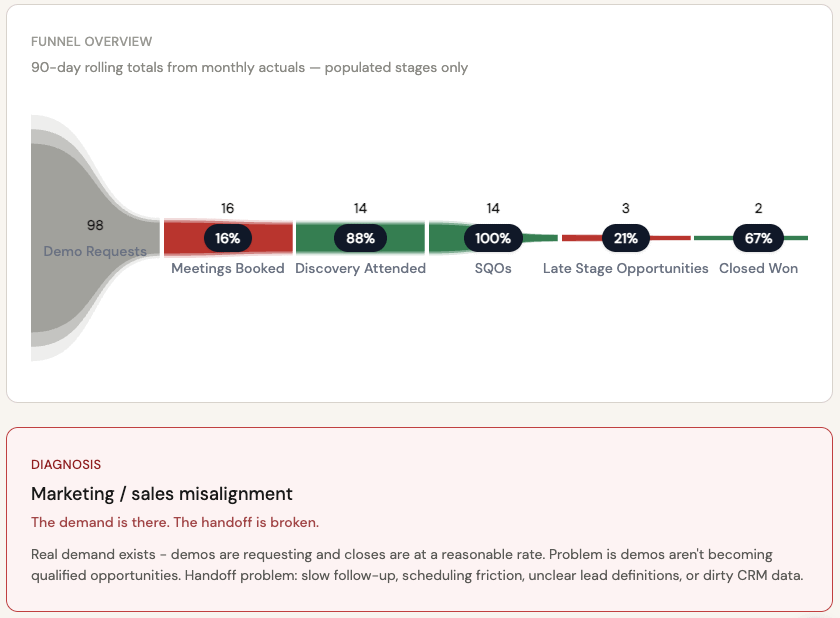
Demo > meeting booked was 4x LOWER than benchmark
This one boggles my mind that some companies still don’t leverage calendar scheduling tools as part of the demo request submission process. They’re inexpensive + pretty much guarantee instant results.
There’s also an insane amount of leverage here:
If you sell multiple products, serve multiple verticals, etc., this can be applied universally + benefit every one of these funnels
With it being near the top of the sales funnel, that means it impacts every stage of the funnel that follows. e.g. if 2x more people book a meeting from demo request, assuming conversion rates downfunnel remain the same, that’s 2x more closed won deals without changing anything else.
So when I came back to them with my recommendation, this was the first slide I presented:
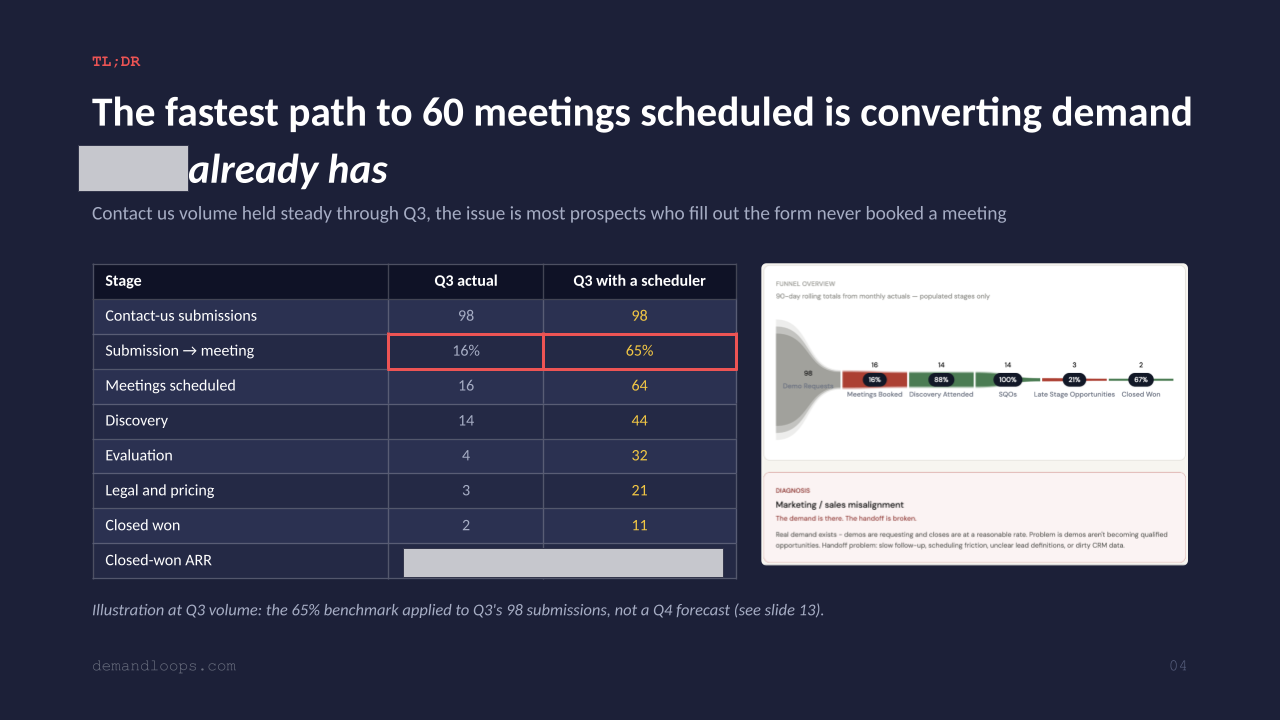
As I said earlier - wild, right???
So aside from telling them I don’t recommend spending more in order to hit this goal, that we needed to solve the submission > meeting booked problem first, I then hit them with a second counter-intuitive recommendation.
I initially thought it’s probably going to take a month or so to get this purchased + implemented, so let’s increase paid media spend during that time to keep the funnel filled. Then I ran the numbers and I realized we needed to do the opposite.
At their current rate, they were paying ~$3,300 per meeting booked. Once the scheduler was live, that same spend would buy a meeting for ~$775. AKA, spending during the month it took to implement meant paying 4x more for the exact same outcome.
So I recommended we don’t push media dollars until the scheduler was live so we could pool every media dollar to go 4x further the last 2 months of the quarter. We’d deploy the same total budget, just holding it until the scheduler was live vs. spending it evenly across the quarter.
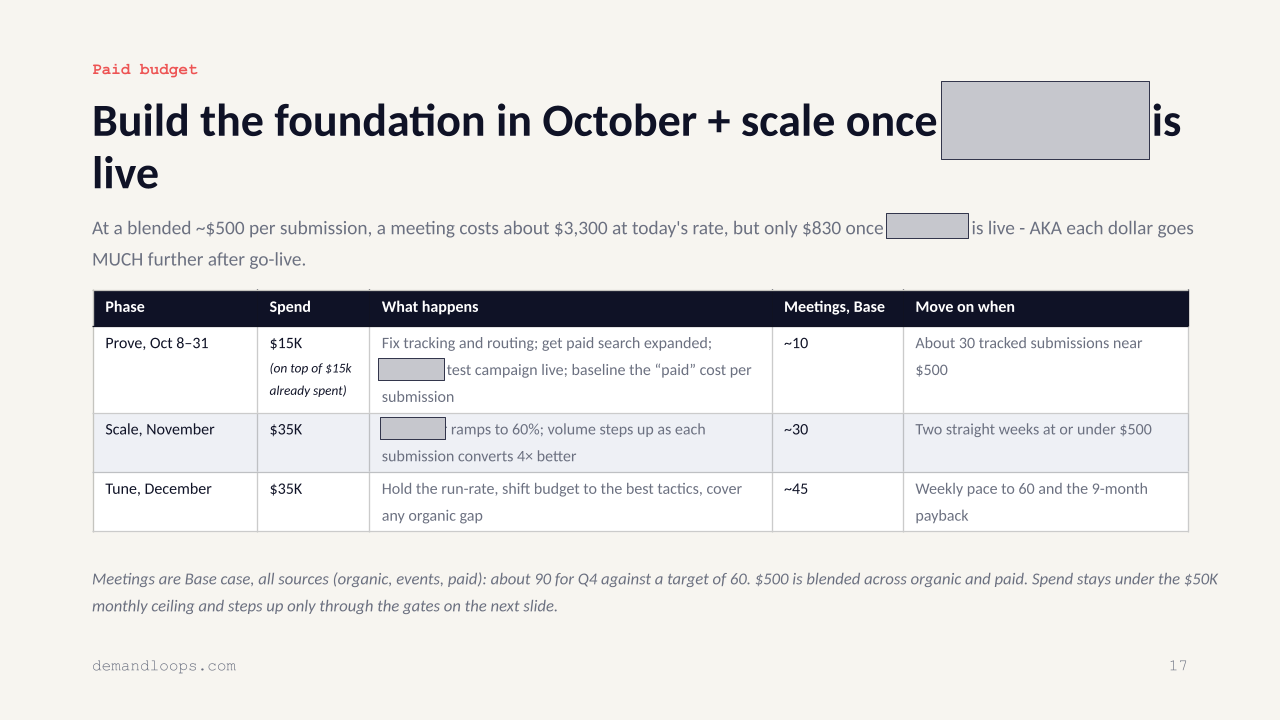
Yes, this type of recommendation to wait to spend always gives me anxiety since it’s compressing the time window to drive results, but I’ve seen the impact this singular lever has enough times to have confidence that they’d easily get to the industry benchmark conversion rate of 65%.
TBH, with every company I’ve worked at or had as a client that implemented this, 65% was lower than what we saw as we were usually in the 75-90% range, so if anything the projected meetings scheduled I forecasted was conservative.
Now it simply became a matter of committing to the plan + treating this as the priority it was.
The takeaway
When we’re given bigger growth goals, most of us almost always default to something like “ok, how much more do we need to spend to achieve that?”. It’s the easiest + quickest lever to pull, and leadership/finance usually understand that an investment needs to be made to drive more demand.
BUT, unless we’re aware of the bigger picture + funnel health, doing “more” or spending “more” is only going to give us “more” of whatever problems we have, like more leads slipping through the cracks.
With this client, we could have spent more to hit the goal, but knowing goals would only be increasing come 2027 + across their other markets, fixing this now was a no brainer to me. Getting a scheduler in place would set us up for future success, help us hit the Q4 goal, and hopefully gain a few brownie points with their finance team as being (what I assumed) the only demand gen partner who recommended not spending more on paid media to achieve their goal.
Before the next “we need more” conversation, pull your conversion rates at each stage + compare it to benchmarks for your industry. The best place to put the next dollar of investment just might not be into paid media, but somewhere else.
See you next week,
Sam