


I’ve been thinking a good bit lately about 2 different spectrums I’ve experienced over my career:
How to market a “nice” to have vs a “need” to have
How to market a known brand vs an unknown brand
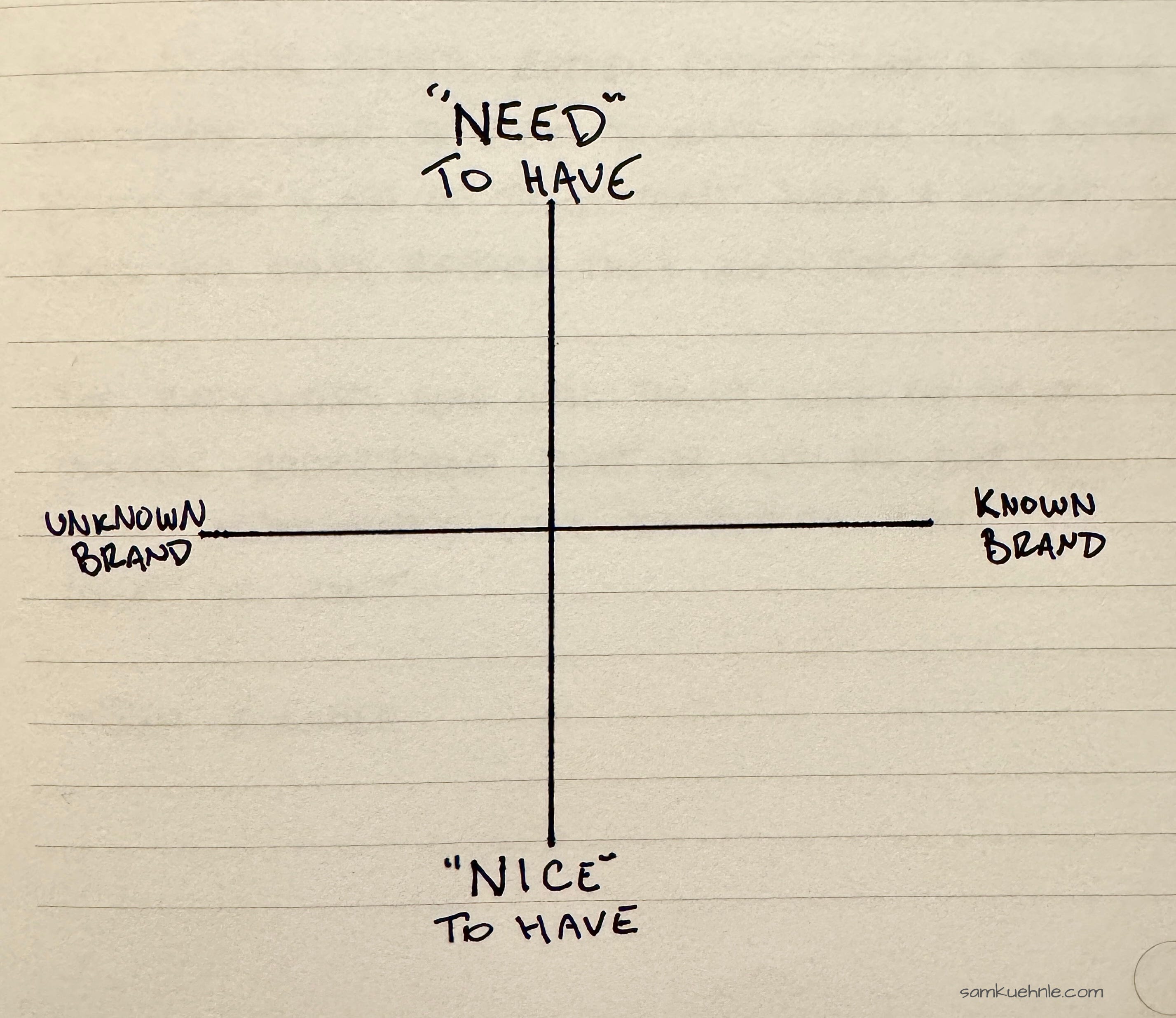
Both spectrums have their pros + cons. Some are more vulnerable to economic cycles, some to advances in technology, etc. Over the years I’d find myself thinking something like “If only I could be working for a “need” to have instead of a “nice” to have, we’d be seeing much better results,”…only to find that when finally given the opportunity to be on the other side of that spectrum, the grass wasn’t as green as I thought + I had entirely different problems to solve.
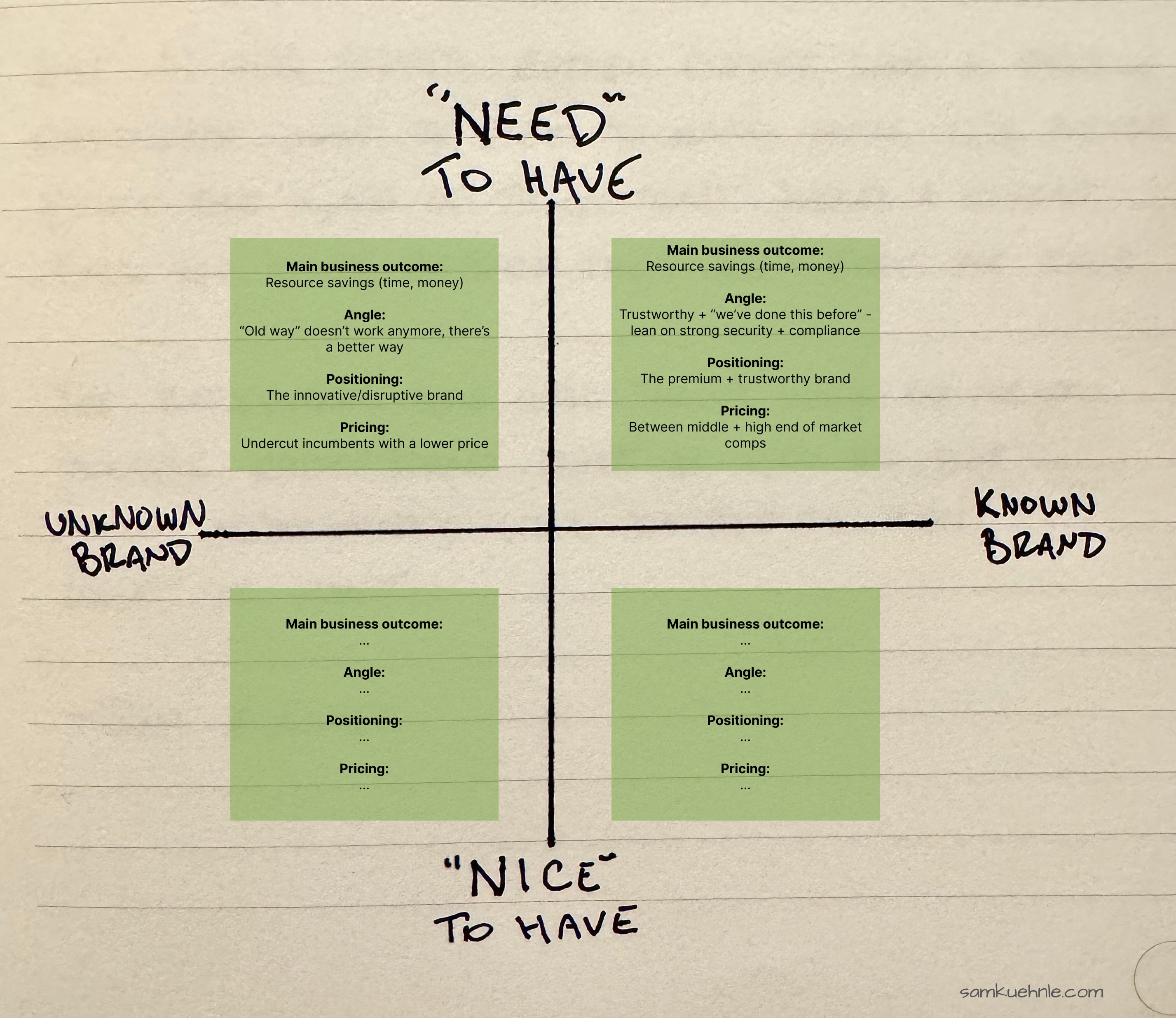
But as I’m zooming out + looking at this intersection of nice/need to have x being a known/unknown brand, there are a few principles + mental models I’ve learned over the years that, while certainly not perfect, are often pretty good starting points to use after charting where your company is on the chart. The mental models for each of these that I’ll break down are: identifying the main business outcome to market, the angle you take, the overarching positioning for the brand, and how to think about pricing.
Two notes before we dive in:
A ton of people reading this will disagree with what I share - GOOD. No frameworks or playbooks should be viewed as dogma or set in stone. These are simply some good starting points that I’ve learned over the years to determine if said framework/playbook/mental model is the right path to continue on OR if we should look at it + say “nope, that definitely ain’t it.”
While using this matrix, also remember that your company is evolving as time goes on as well. You’re probably going to move along one or both of the spectrums as time goes on and/or work for different companies over the years that occupy differents spaces on the axes
Sponsor: Affect
Affect is the framework for how I think about marketing accountability. The playbooks I’ve built from 15 years of seeing what works + what doesn’t and recognizing that the purpose of marketing isn’t to hit vanity metrics like MQLs, but to move the business.
Affect is for the marketers who have sat in a room where marketing celebrated surpassing its MQL targets while the business missed revenue. It’s for the marketers who want to be held accountable because they’re confident enough in their work to let the math speak for itself. It’s for the marketers who understand that clarity is earned, conviction is a choice, + being a force on the business is the only version of this job worth doing.
August is the last month to grab the founding member rate at $99/mo, locked in for life. A ton of enhancements are coming out in Aug, Sept, and beyond, so be sure to grab this before pricing goes up to $399/mo. Or, as one of the first users said:
“It’s $99 and cancelable after 30 days, it’s pretty risk-free. I pay more for an Uber to the airport.”
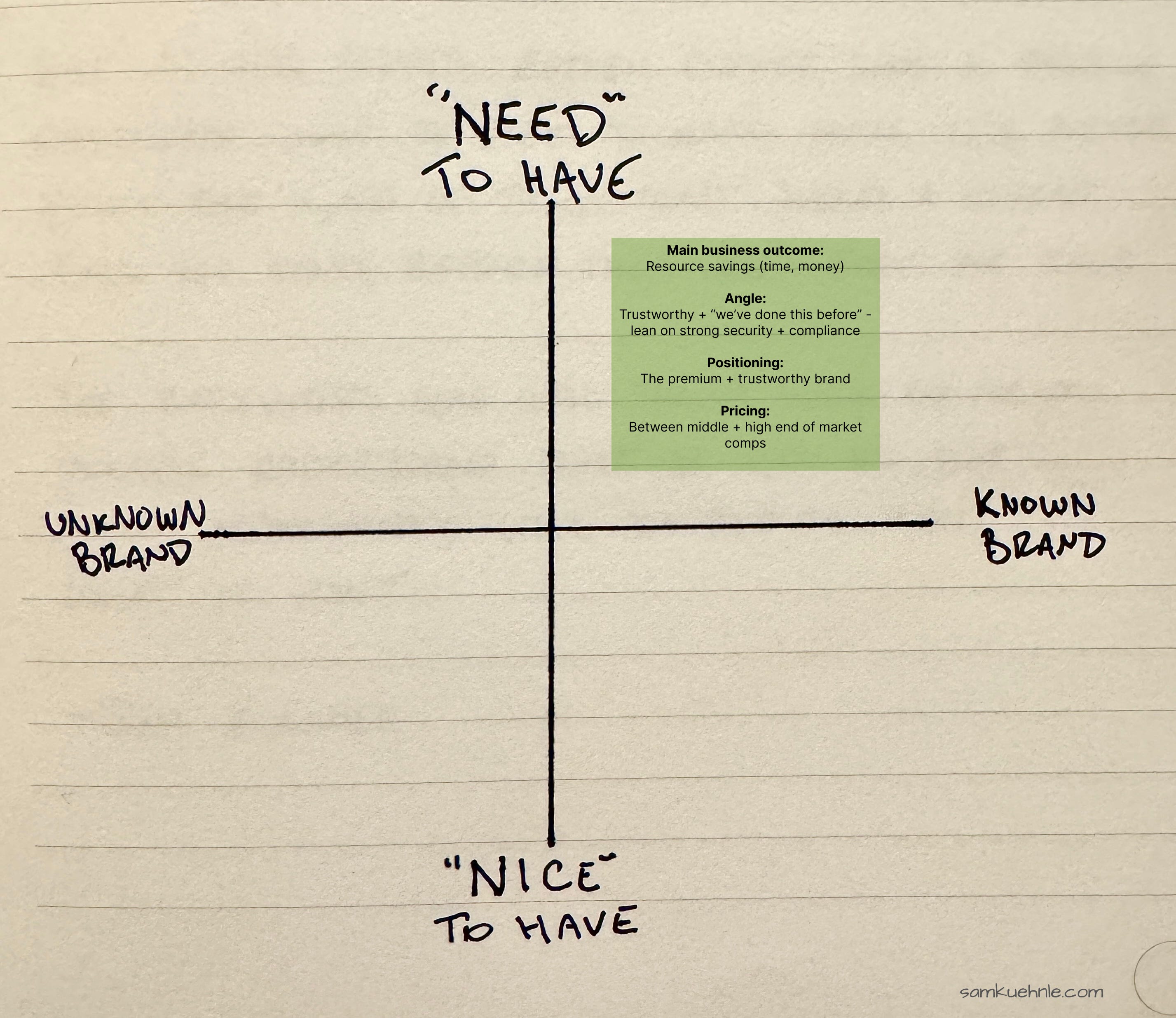
Need to have x known brand
In a scenario like this, you’re selling something that your market requires in order to operate, and those in the market have most likely heard of your brand before.
For those in the tech world, examples of this combination would be something like a sales CRM (i.e. Salesforce) or accounting/finance software (i.e. Quickbooks). While a company doesn’t technically need these in order to operate, they’re pretty much foundational infrastructure (unless you’re a masochist + enjoy doing everything manually in spreadsheets).
Now for the 4 mental models…
Main business outcome
You’re selling something that the market knows they need, so more likely than not, you’re playing in an existing category with other options. As a need to have, unless you’ve found some crazy technological advantage, you probably aren’t going to help the prospect to make more money, so of the 3 main reasons that anyone buys software/services (save time, save money, make money), that rules that outcome out as something to lean on. That leaves us with save time/save money, which we’ll merge into one for simplicity - save resources.
So whether that’s understanding that your sales CRM has a better UI + allows the user to accomplish their tasks faster, or that the accounting software is able to consolidate what used to be done across 2-5 systems into 1, this is where you’ll figure out your “bottom line” orientation that’ll go into the prospect’s business case that requires some form of ROI number in order to be approved.
Marketing angle
This is where we play into being a known brand more. You’re in a crowded category + the market needs your software/services, so one of the strongest things you can communicate here is that you’re a well-known brand. Multiple companies trust you as shown by all of the logos you’ve acquired. You’ve helped so many customers at this point that you have a seemingly never-ending repository of case studies highlighting the results you’ve helped customers achieve. And for winning over the IT + Finance teams, you probably have a very secure + stable infrastructure so they won’t need to worry about downtimes or not meeting compliance.
This one isn’t sexy, but you don’t need to be. Very few companies are able to live at this intersection of being a nice to have AND being well-known, so don’t be shy about pointing to your track record. There’s a reason the saying “no one ever got fired for buying Microsoft” continues to this day…
Brand positioning
So you’re a need to have and the market knows you. By being known in the industry, you’ve overcome one of the hardest challenges which is simply making it to the “recall” list for anyone in the market you serve so you have a near guarantee on making the shortlist for purchase. Play into that here.
Find a way to give off “premium” vibes if you can. Not just a “we’re here to rest on our laurels”-type vibe, but demonstrate that not everyone can use your software/services. That being a customer of yours gives off a signal to the customers’ market that they’re real business operators if they’re partnering with you. A good example of this right now is Vanta. Far from sexy category, well-known brand, and by slapping their credentials on your website, your prospects immediately know you take security + compliance seriously.
Pricing
Alright, rounding third + heading toward home. You’re a need to have, your brand carries weight, and you’ve demonstrated that there’s a bar to entry in order to use your software/service. That last part is what we’re going to leverage when it comes to pricing.
If you’re too expensive, the market will flock to more affordable options because you’ve priced yourself out of too many budgets. If you’re too cheap, it can leave the sense that the quality may not be there when they start using your software/service. So we need to meet (a little) past the middle here. When running market comps, you’ll want to sit somewhere between the middle + high end of the market. For example, if the average comp in your market is $1000 per month, it might be worth pricing somewhere between $1200-1500 per month. Remember: your market is buying your reputation - make sure you price that in + don’t sell yourself short.
Need to have x unknown brand
Now we’re on the flipside of the known/unknown spectrum when competing in a “need to have” category. The market still needs what you’re selling in order to operate, BUT you aren’t familiar to most of them yet. You may be a newer entrant or expanding into an adjacent market that you hadn’t previously served.
Continuing the example from earlier for those in the tech world, examples of this combination would be something like a sales CRM (i.e. Attio) or accounting/finance software (i.e. Mercury). While a company doesn’t technically need these in order to operate, they’re pretty much foundational infrastructure (unless you’re a masochist + enjoy doing everything manually in spreadsheets).
Now for the 4 mental models…
Main business outcome
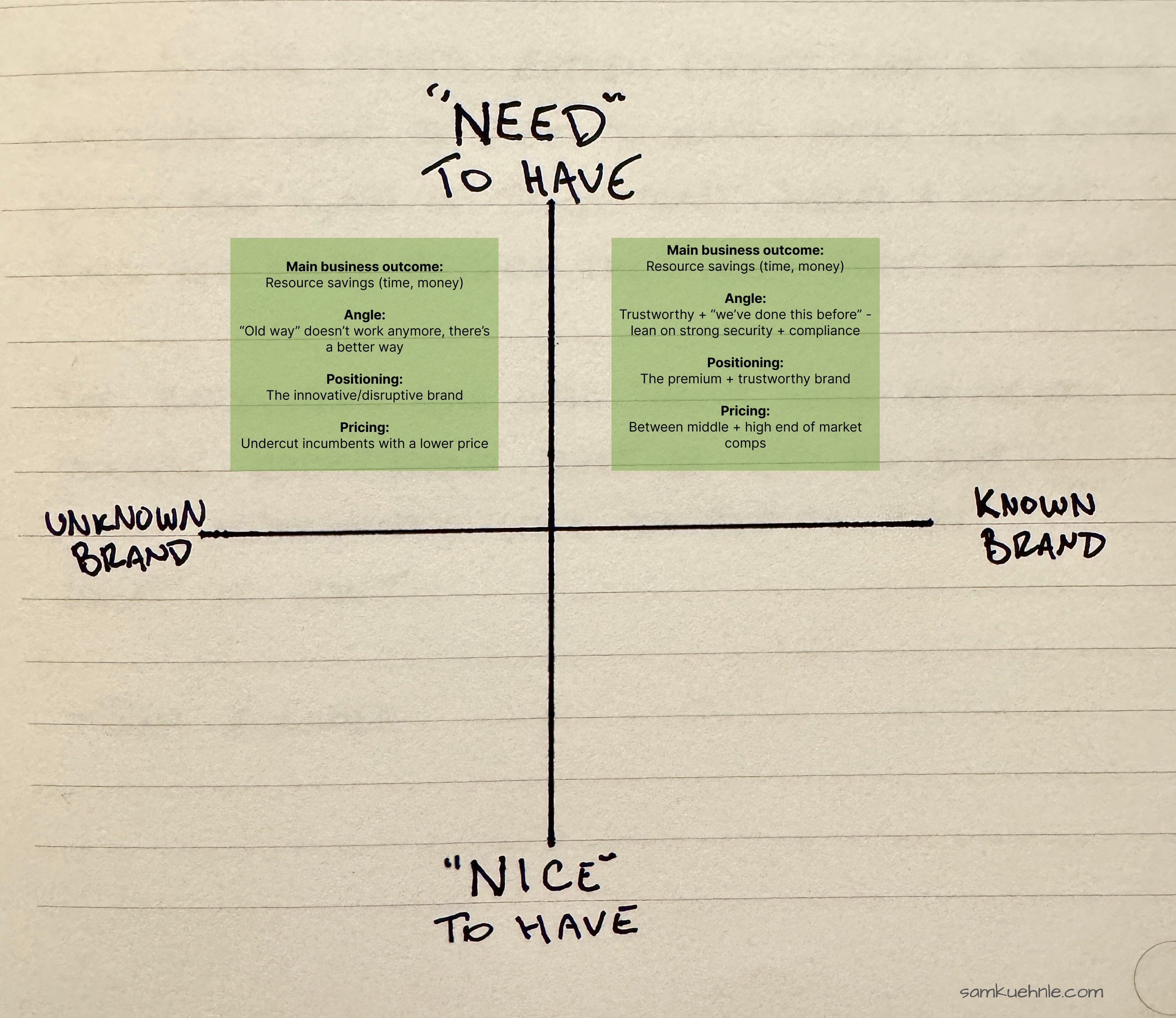
Still playing in the “need to have” space means it’s unlikely that you have a unique differentiator or value prop that finds a way to help your market make significantly more money than the alternatives, so you’ll most likely continue playing on the resource savings (time/money) outcome here.
Pretty similar rundown to what was shared above when you’re a known brand, so what was shared in there will transfer near equally to an unknown brand.
Example: Attio in the sales CRM space. Crowded category, big name incumbents, they’re newer + leaning hard into time savings + a more efficient workflow.
Marketing angle
Now is where we get to start having some more fun. Being a more unknown brand in a need to have category most likely means you’re a newer entrant to the space or have innovated your way in from an adjacent space. While the known brands are relying on their reputation + time in the space, the upstarts here have a window in time where they can come in with “fresh eyes” and help paint that picture for the industry.
This often comes in the form of “old way/new way” messaging where you point out the way things “have always been done” as the old way, and then present a new way - often one that is faster, more efficient, and/or more cost-effective than the old way. I’ve used this one a few times over the years by using a simple table that contains a few use cases/jobs-to-be-done for the market and has the old way of doing it on the left hand side + the associated cost (time/spend), then on the right hand side the new way of doing it + the associated cost (which will always be an improvement on the old way if you’re showing it in this table.)
Pro tip: the old way/new way table is great, but an even better move is when you can present this in the form of the “cost of inaction,” i.e. what is the prospect leaving on the table if they don’t make a change. Showing how much time/money that could’ve been saved + how that compounds over time can be quite compelling…
Brand positioning
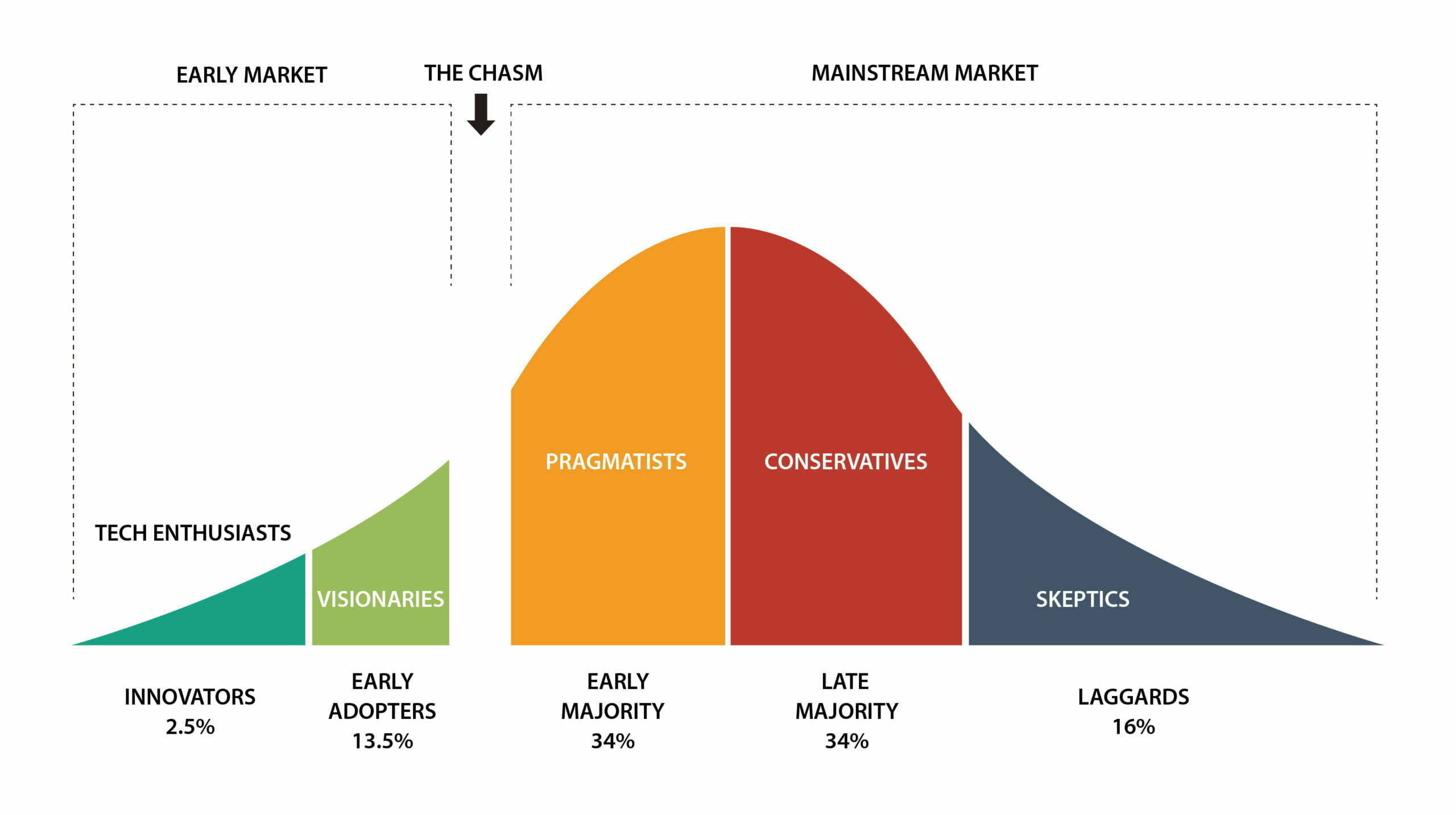
This is a fun one + one that I’ve seen taken any number of ways over the years by various brands. There’s no one best way to do this, but one that I’ve seen consistently work well is positioning yourself as an innovator/disruptor to the space. It plays hand in hand with the old way/new way angle you’d be using AND also plays well into the technology adoption lifecycle curve by attracting the innovators + early adopters. While this group may only make up 16% of the total market, they’re the ones who help build some serious momentum + positive word of mouth, so the faster you can attract them + allow them to be more successful than they were with their previous vendor, the faster your acquisition flywheel will go.
As a bonus, when you choose to position yourself as innovative + disruptive, that allows for you to be more aggressive with your branding + have a strong POV to communicate to the market. Innovators + disruptors rarely have logos + websites with the typical lethargic SaaS blue or watered down messaging. But as time goes on + you go upmarket, companies are often forced to “mature,” so now is the time to put a stake in the ground for what your brand is, and equally what it isn’t.
Pricing
Alright so we’re in a crowded category with legacy players who own most of the marketshare. We’re going after the innovators + early adopters who are willing to take more risk in order to capture an increased reward on the backside of it. And since this is a need to have, it’s probably going to overlap for some time with the incumbent or be scrutinized by finance to get to positive ROI quickly.
In order to capture marketshare in a reasonable time + convert the business-oriented decision makers signing the contract, one thing that almost always makes it more palatable for them is if the contract costs less than their existing one for the same product/service. You don’t want to go crazy and severely undercut the competition as you’ll be viewed as a discount product/service, but being able to say to a prospect that they’ll save 10-25% from what they’re currently paying for the same/better outcomes can be compelling.
Note: make sure you run the numbers on your overhead + acquisition costs so you aren’t looking at a CAC payback period that’ll have you upside down for 3+ years. Technology + knowledge is advancing faster + faster, so whereas many companies used to be changing key providers maybe once every 5-8 years, this has moved to a 2-4 year window now, so if you aren’t profitable within that time, your business won’t be around for too long…
What about the “nice to have” companies?
Stay tuned for part 2/2 of this series next week that’ll breakdown the “nice to have” elements of the equation + how to identify and leverage your unique force multiplier (or what I call the brand coefficient)…
See you next week,
Sam