


“An interesting follow up would be how brand marketing spend fits into the picture and how you account for it internally. (addressing the point about only so many channels and diminishing returns over time).”
This was a question my friend Justin Norris asked in a comment to last week’s newsletter about common funnel issues. I thought it was a great question. Some of you may have been thinking it as well, or some of you may encounter a scenario over time where this question becomes relevant.
It’s a hard question to answer definitively as there’s no one “right answer” to it, but in the mindset of these being marketing meditations, I sat down with Justin’s question + here’s what I ultimately came up with.
Sponsor: You/Your Company?
If you’re looking to get in front of an engaged audience of some of the savviest marketers + GTM practitioners, this is your opportunity. One opening per month to sponsor this newsletter has become available + I’m sure will claimed quick, so if the audience reading this newsletter is your ICP, this is your chance.
A few weeks ago I was talking to a VP of Marketing + they said they were exploring/in negotiations with one of the sponsors of this newsletter after learning about them here + seeing them as a product that I endorse. That’s the power of these types of partnerships done well (vs. the AI influencer dumpster fire some are experimenting with).
Simply reply back to this email if you/your company is interested or drop me a DM on LinkedIn.
But what about brand?
This is essentially what Justin’s question was asking.
How does spending more/less on it change things?
And how does (or doesn’t) this fit in with the models + numbers shared last week?
After sitting with this question for a minute + going past the superficial “most companies have a brand budget and a demand budget” response, I realized it was an answer that was obvious in my head, but when reflecting on it, is not something that’s widely adopted/accepted in our space.
The reason for this is that we can’t optimize our funnels without thinking about how brand comes into play. BUT, the hard part is where brand does affect the funnel is rarely explicitly called out. We all can feel what happens when brand impacts our funnel, but surprisingly it’s not brought up in many conversations.
So with those two cliffhangers (what was obvious to me and where does brand affect the funnel) now lingering, let’s unpack them.
Brand vs. demand → brand + demand
Brand and demand aren’t separate. They’re two expressions of the same thing - building preference within your market.
I personally view them as one and the same (yes, I know they aren’t in reality, just hear me out…). To me, good marketing bridges both at the same time.
That said, as I really think about it, I find that I skew heavily toward brand. But why?
The power that a strong brand association can create, the long-term recall seeded into the market for what you want to be remembered for, the virality/word of mouth that can occur when you have happy customers, etc. - how those play out shows how brand is a MUCH stronger lever AND lasts far longer than many of the traditional “demand gen” marketing levers, especially those geared specifically for problem aware/solution aware audiences.
At the end of the day, no one really wants to buy software. They just want to solve a problem more easily OR use it to be able to make more money. So when we do go to market to purchase something like software or services, emotion plays into it more than we may be willing to admit.
Yes, there are very cut + dry boxes that need to be checked. “Does it have XYZ functionality” etc., but when we actually go on to making the decision of who we buy, some boxes that will never show up in the comparison are things like:
Do I like the sales rep we’ve been working with?
How will recommending company A vs company B make me look when presenting this to leadership/the board?
etc.
And you know what category those elements fall into? Brand. That’s all about company DNA, how they hold their team members to operating, and their perception in the marketplace.
That’s why brand is such an under-invested in item. It’s not always a function of dollars or separating out ads that are focused on your logo vs. ads focused on a product UI shot.
It’s the standards the team is held to that show up in how they engage with prospects + customers. It’s the little details executed upon at a local event with 15 attendees. It’s having an actual POV that the market also feels and as a result draws them to you because it’s a company that finally “gets” them.
Where brand hits in the funnel
Pulling an example funnel from last week’s newsletter, let’s say this is your current funnel. Before you scroll down, where do you think having a strong brand would improve your funnel? Which variable in here?
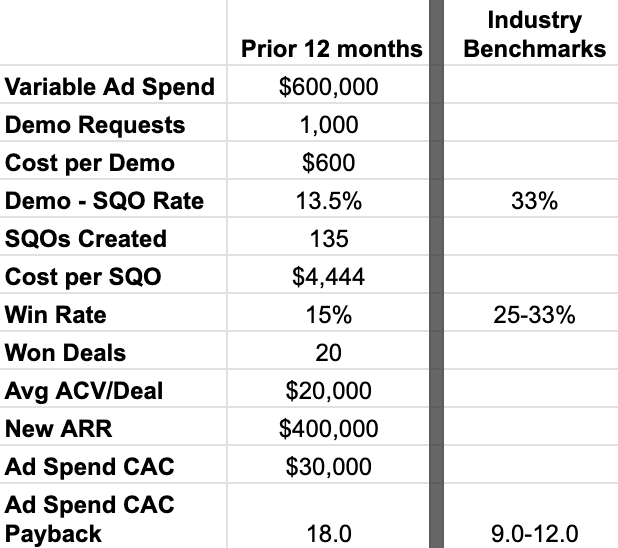
Trick question. TBH, the answer is “where doesn’t brand hit in the funnel?”
When you have a strong brand, you’ll see it show up in multiple places here:
Demo - SQO rate (prospects are being organically pulled through the funnel vs. pushing/forcing them through)
Cost per SQO (while cost per demo may be higher by not forcing prospects through the funnel, since they convert at significantly higher rates, that means you’re driving REAL pipeline at a much lower cost)
Win rate (they want to choose you, they just need to do their due diligence)
ACV (in tandem with the above, you don’t need to dangle discounts or special deals in front of them to convince them to buy)
If I had to point to just one of these though as where it hits “hardest,” I’d say it’s in the demo - SQO rate variable. That’s where there’s the most volume available to be impacted (funnels are a numbers game, after all).
In a “standard” funnel where a prospect is pushed/forced through, this number is typically low and, as a result, means the funnel gets narrow very quickly.
In a funnel where there’s a strong brand involved, this number is typically high and, as a result, means the funnel stays much wider as most of those are qualified.
This is why I like brand advertising more than traditional demand gen/performance marketing ads. Those are trying to capitalize on a very specific time for the prospect where they’re problem aware/solution aware AND actively evaluating. The problem here is they’re wired more in shop/compare mode than “ooo, I like this brand” mode.
Brand gets out ahead of this well in advance of problem aware/solution aware. They’re simply out there existing + consistently staying in front of the market ultimately saying, “I see you and understand you.”
This is what develops trust. And that trust is exactly what drives the higher demo - SQO rate when they enter the funnel.
They trust us. They know what we’re about. They see we aren’t just trying to make a quick buck off of them based on the time we’ve spent in front of them. So they’re asking different questions in the demo. They’re looking to confirm their decision, not be persuaded. Better fit prospects in the funnel + easier conversation for the sales rep = higher demo - SQO rate.
Quick: you need to make a recommendation for a sales CRM for your company right now, who are you recommending?
That’s brand at play.
I’ve spent years optimizing funnels and improving all of the demand levers available to us.
Cost per demo? Tighten the targeting to true ICP + watch wonders happen. Demo - SQO rate? Let the prospect schedule the date/time of the demo when filling out the form. The list goes on (what was covered in last week’s newsletter).
But when you zoom out + look at larger datasets, there’s also a more binary variable that I can apply to quickly assess how strong a company’s funnel is:
Their brand.
If no one knows who you are or they don’t trust you, you can have all of the right demand optimizations built into your funnel, but it’ll still be a weak funnel.
Then on the flip side, if you have a strong brand + people trust you, you can have just some of the right demand optimizations built into your funnel and/or mediocre demand gen tactics in play, and it’ll be a stronger funnel than the one above.
In the past, I’ve talked about this under the context of brand awareness relative to demand creation. And it holds true here as well as this is where the force multiplier effect comes into play.
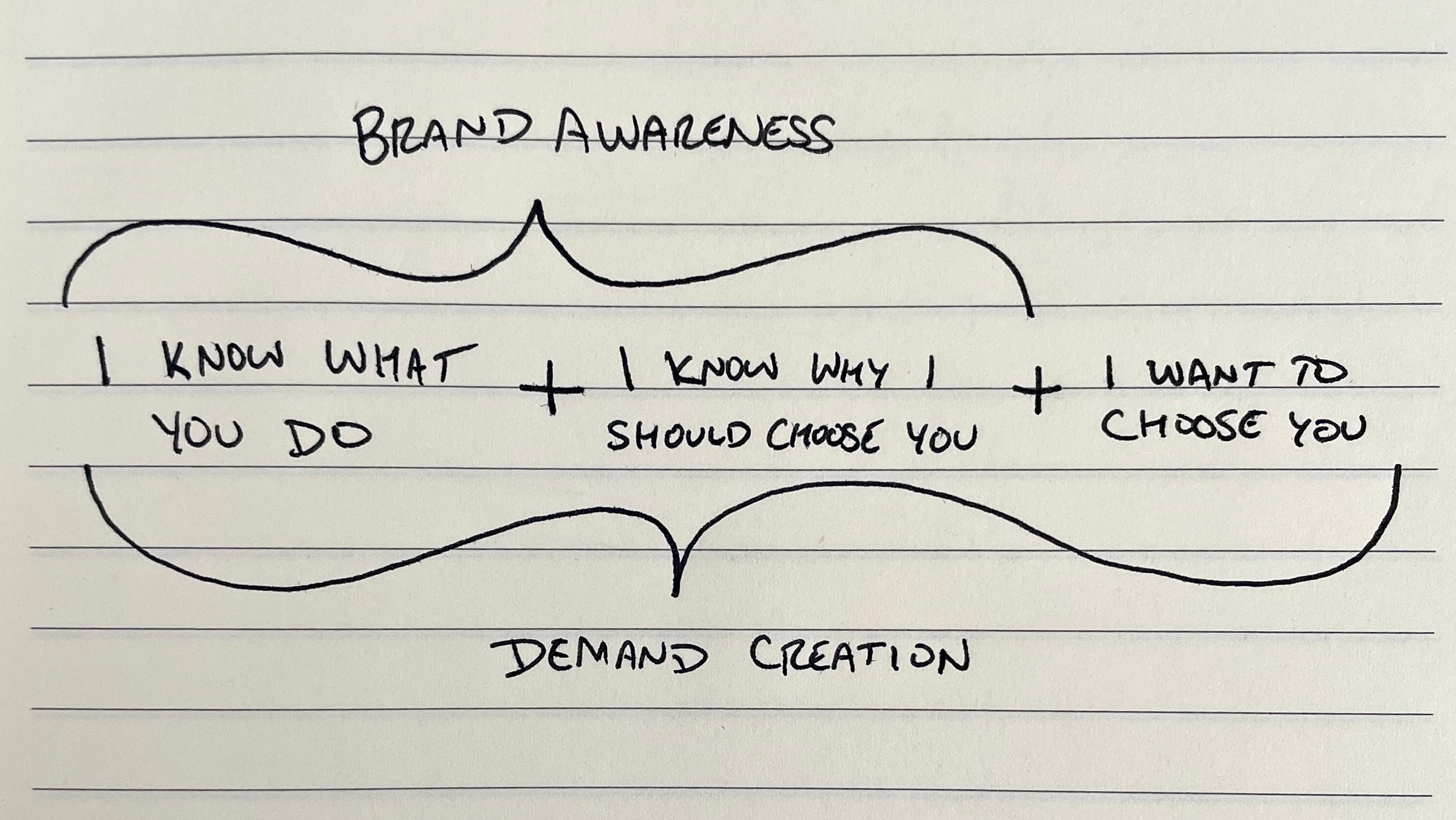
This was the moment of clarity I had when thinking about Justin’s question. It was realizing my definition of brand isn’t the traditional “brand awareness” definition that covers the first two items in the above equation (I know what you do + I know why I should choose you). To me, brand also needs to contain the third, and most important, element - the ability to make your market want to choose you.
This is the force multiplier of having a strong brand.
The brand coefficient
We need to stop separating brand + demand in our org charts, budgets, + strategy.
They aren’t opposing forces competing for the same dollar to be allocated to them. Brand is what makes demand gen actually work.
Demand gen gets people in the door.
Brand makes them actually want to walk through it.
The companies that have figured this out don’t talk that much about “brand budget” vs. “demand budget.” They intuitively understand that it’s about building preference while they’re building awareness - same effort, just viewed through a different lens.
This is why I can help you optimize your cost per demo down by 50%, but it still won’t matter if you don’t have a good brand/nobody wants to buy from you. And on the flip side, why having a strong brand makes mediocre demand gen tactics work better than they should. (This has always been one that drives great demand gen marketers crazy - “Our campaign is so much better than the market incumbent’s. Why aren’t we getting more demos???”)
Ultimately where this all takes us to is that we need to stop asking “should we invest in brand or demand gen?” + start asking “how do we strengthen our brand coefficient?” This is where the real leverage lies as at that point, we aren’t deciding between two things - we’re multiplying the effect of one with the other.
And this plays out in the following way:
Your funnel gets wider.
Your conversion rates improve.
Your sales team has easier conversations.
Your customers stick around longer because they actually chose you, not just defaulted to you.
That’s the brand coefficient.
Book quote of the week
“In Silicon Valley, nerds are skeptical of advertising, marketing, and sales because they seem superficial and irrational. But advertising matters because it works…It’s easy to resist the most obvious sales pitches, so we entertain a false confidence in our own independence of mind. But advertising doesn’t exist to make you buy a product right away; it exists to embed subtle impressions that will drive sales later.”
- Zero to One, by Peter Thiel
See you next Saturday,
Sam
Every single thing a company does is branding. What you are getting at is active branding as in campaigns to say "My brand is X" and passive branding which is everything else. But every communication and action a company and its employees take is a reflection on the brand.
Organizations are a collection of brands: company, personal , product/service. Demand amplification comes from brands working in concert but each brand has a different function in the market:
Company - who we are and what we do
Product Service - what it is and what it delivers for you
Personal - trust and authority in a vertical space that we can deliver what we say we can
Podcasts are personal branding exercises developing your authority that then translates into trust - "Sam knows what he is doing, he would not endorse a product if it was bad."
Advertising - we just saw the mother of all advertising twice in a few weeks - the Superbowl and the Olympics - two places where broadcast branding establishes the persona of your brand - who you are and what you do and what you believe
And then the vast majority of the GTM motion is centered around product/service and aligning the features and benefits of a product/service to the pain points and needs of an ICP
So branding is a force multiplier. Powerful brands are a component of a gravity well that attract customers to you when they become aware of a problem and you might be the solution.
At Bill Me Later, we talked about brand equity and how to measure it. Inevitably, we came down to this: the multiple. The company did $56 MM in revenues and had an offer to be purchased for $1.7 billion. That means the brand is worth over a billion. Turned out the business sold for $965 MM but is a $15 billion components of the PayPal portfolio. Not too bad.
Sam, the brand coefficient framing is spot on. Brand is not a line item next to demand. It is the multiplier that makes demand work. What resonated most: “They’re looking to confirm their decision, not be persuaded.” That one sentence explains why strong brands convert better at every stage. The funnel does not get wider because you push harder. It gets wider because people already trust you before they enter it. Great piece. 🦊🎓