Over the past month I’ve been going down a copywriting + offers rabbithole. More specifically, the rabbithole around the timeless principles of doing this well, NOT some clickbaity form of “HoW tO cOpYwRiTe N gEt LeAdZ iN 2026” from someone who’s never actually sold anything other than those types of online courses…
Anyway, as part of this rabbithole tour, I’ve been going through the classics: Claude Hopkins, David Ogilvy, Gary Halbert, John Caples, etc. and have been filling up my notebook faster than ever before. Principles validated that we’ve been doing, foundational things I’ve found we’re drifting away from + need to come back to, and tactics that we hadn’t been using at all + put into our mix as soon as I finished reading the section.
After re-reading my highlights, I wanted to create some form of a lesson/takeaway that I could come back to as time goes on from each of these books. So today we have the first of these as I unpack my learnings + interpretations from “My Life in Advertising & Scientific Advertising” by Claude Hopkins.
Sponsor: Affect
Affect is the framework for how I think about marketing accountability. The playbooks I’ve built from 15 years of seeing what works + what doesn’t and recognizing that the purpose of marketing isn’t to hit vanity metrics like MQLs, but to move the business.
Affect is for the marketers who have sat in a room where marketing celebrated surpassing its MQL targets while the business missed revenue. It’s for the marketers who want to be held accountable because they’re confident enough in their work to let the math speak for itself. It’s for the marketers who understand that clarity is earned, conviction is a choice, + being a force on the business is the only version of this job worth doing.
Founding member rate is still available - 41 left at $99/mo, locked in for life. Or, as one of the first users said:
“It’s $99 and cancelable after 30 days, it’s pretty risk-free. I pay more for an Uber to the airport.”
How to think about marketing
"When you once get a person's attention, then is the time to accomplish all you ever hope with him.
Bring all your good arguments to bear. Cover every phase of your subject. One fact appeals to some, one to another. Omit any one and a certain percentage will lose the fact which might convince.
People are not apt to read successive advertisements on any single line. No more than you read a news item twice, or a story.
In one reading of an advertisement one decides for or against a proposition. And that operates against a second reading.
So present to the reader, when once you get him, every important claim you have."
This is one that I realized I wasn’t doing a good job of.
I assumed the prospect reading the ad or hitting our landing page would be naturally curious enough to go to all the other relevant pages to learn all about our entire platform + the problems we could help them solve.
Nope.
This passage was the realization that many would only read what was put right in front of them + if that wasn’t compelling/insightful/helpful enough for them to go on reading, they’d leave. And while future ads would help bolster recall, they probably wouldn’t click/read anything since they already formed an opinion about us/our platform.
So after making sure the headline grabbed their attention + pulled them in, I drafted the supporting copy to round out the story AND then go on to speak to all the other outcomes that they desire.
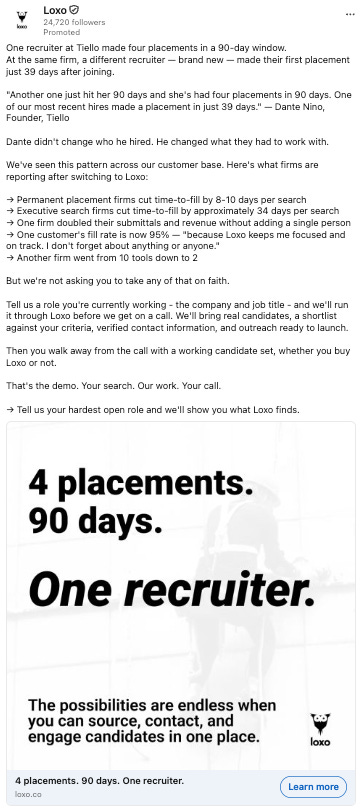
Fun fact: CTR on this ad is 1.46% (avg LinkedIn ad CTR is 0.3%) + dwell time is 11.48 sec (avg LinkedIn ad has a 3.6 sec dwell time), so I think Hopkins was right on this one 😉
The power of show, don’t tell
"Mother made a silver polish. I molded it into cake form and wrapped it in pretty paper.
Then I went from house to house to sell it.
I found that I sold about one woman in ten by merely talking the polish at the door.
But when I could get into the pantry and demonstrate the polish, I sold to nearly all.
That taught me the rudiments of another lesson I never have forgotten. A good article is its own best salesman. It is uphill work to sell goods, in print or in person, without samples."
This was something I noticed early on for us. We were creating a new category, so no one really knew (or cared) what a “Talent Intelligence Platform” was.
But as soon as I started dropping in 30-90 sec use case videos showing the different jobs-to-be-done our ICP encounters every day + how easily our platform handled those, that was when the lightbulb went off for our prospects + we spurred a ton of inbound demos.
Saying things like “recruit faster!” or “get better candidates!” aren’t unique + don’t mean anything to a recruiter who gets bombarded daily with those types of promises. But showing them how that could be done + in a manner different from what they were used to - that was where the magic happened.
Storytelling + specificity
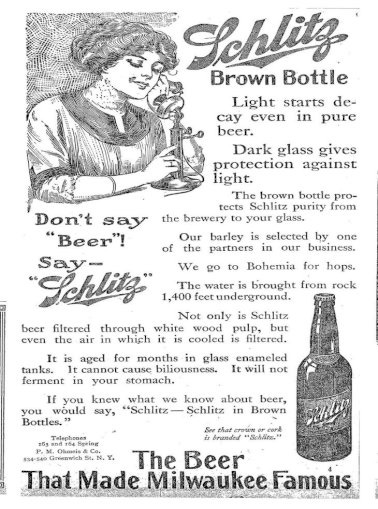
"I went to a brewing school to learn the science of brewing, but that helped me not at all.
Then I went through the brewery. I saw plate-glass rooms where beer was dripping over pipes...They showed me artesian wells, where they went 4,000 feet deep for pure water...They showed me the vats where beer was aged for six months before it went out to the user. They took me to their laboratory and showed me their original mother yeast cell.
I came back to the office amazed.
I said: 'Why don't you tell people these things? Why do you merely try to cry louder than others that your beer is pure? Why don't you tell the reasons?'
So I pictured in print those plate-glass rooms and every other factor in purity. I told a story common to all good brewers, but a story which had never been told. I gave purity a meaning.
Schlitz jumped from fifth place to neck-and-neck with first place in a very few months."
Building off of show, don’t tell, when you do need to tell, do so with specificity. That is what lends credibility + weight to what’s being said.
It’s super easy to say things like “trusted by thousands of recruiters!”, but an entirely different thing to say “used by 10,200 recruitment firms across 23 countries.”
But one thing I’m still working on doing for us is taking Hopkins’ storytelling approach above to walk a prospect through that specificity. Helping them see the knowledge, thought process, etc. that fuels the product they’d be using. Understanding what insights + data were found that illustrate how we aren’t just another piece of recruitment software, but how it was built + curated uniquely for them.
That’s where a believer is made.
What NOT to do
"One may gain attention by wearing a fool's cap. But he would ruin his selling prospects."
This is one I felt in my bones with the rise of AI slop + oversaturated feeds recently. It’s harder than ever to stand out + gain attention, so the “easy” solution to this is to put on a monkey costume + dance.
Yes, that’ll work - you’ll get eyes, but not all eyes are good eyes.
This can be taken literally in the sense that you could be capturing the attention of individuals who aren’t in your ICP, so that attention doesn’t ever turn into any business.
But it can also be eyes watching this type of marketing similar to how one watches a car crash happening in real-time - you want to look away, but you can’t…

And this then turns into a negative association with your brand/product. An impression/view occurred, but if all it did was turn off the prospect + even burn them from ever wanting to buy in the future, is that the type of attention/impression you really want to make?
Why it works
“Two men came to me, each offering me a horse. Both made equal claims. They were good horses, kind and gentle. A child could drive them.
One man said, 'Try the horse for a week. If my claims are not true, come back for your money.'
The other man also said, 'Try the horse for a week.' But he added, 'Come and pay me then.'
I naturally bought the second man's horse.'"
There’s something about subtle confidence that just works well.
More specifically, when it’s future-oriented. Like how the second man in this story said “Try the horse for a week. Come and pay me then.” as he knew that the individual would be happy + buy it.
So I tested something similar. Presented an offer where there’s zero downside for the prospect. They send us the role they’re trying to recruit for + we come to the demo with that already loaded into the system, qualified candidates + their contact info + an outreach sequence ready to be turned on to pull them into the candidate pipeline.
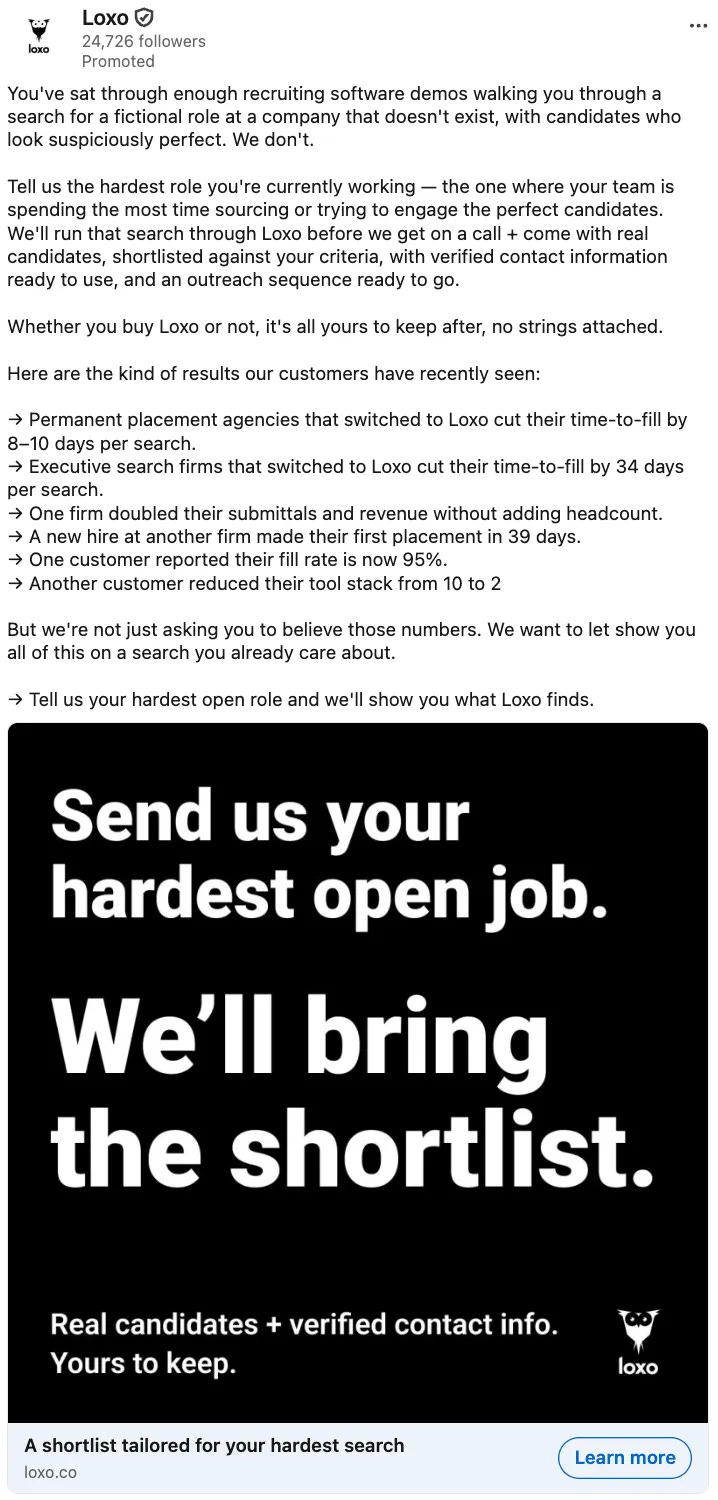
Whether the prospect goes on to continue the conversation + buy or not, all of the info is theirs to keep after, no strings attached.
From our data, we know the rate at which prospects convert when they get to see the platform in action + with relevant examples to them, so this is why we’re able to lead with that type of subtle confidence here + why the time put into this ahead of time will always net out positively for us as this scales.
Wrapping up
These principles work because they’re built on understanding human nature, not chasing the newest/shiniest trend. Hopkins wrote this in 1923 (103 years ago!) and they’re still relevant. The mediums since then have changed (i.e. social ads vs. print), but the underlying fundamentals haven’t.
So that’s why I think going back to the classics matters. A lot of marketers are chasing silver bullets + trends that’ll only last for a few weeks/months, then it’s back to the drawing board to find the next one. There’s no consistency being built in how they’ll attract their market. The fundamentals in these classics prove there are other ways. If something’s been working for 103+ years, I’d be willing to bet it’ll probably continue to work for a few more years 😉
See you next Saturday,
Sam
P.S. cool new feature in Substack that detects AI writing in publications. Here’s what this newsletter scored on the “AI slop” scale 😜