


Hellooooooo friends! Officially back after my mini-break as I took a week off between wrapping up at Loxo and sharing the news that I’m betting on myself as a fractional demand gen operator + pushing harder on Affect.
I’m just about at capacity already (I cap things at 4 clients), which was the thing I was most nervous about in transitioning from employee > employer, but I’m incredibly bullish about what Affect will be able to provide at scale in helping marketers identify their growth constraints, enabling them with the knowledge to break past them, + then providing the “proof” that their decisions were right in the form of showing the outcome you drove (impact on the variable + resulting revenue over time).
All that to say, I’m back in my happy place of working directly with marketers every day, so expect LOTS of more geeking out on all things in that world + drop me a line if there’s ever anything you want to chat through! Can reply back here (these come to my inbox) or shoot me a note at sam@derevaco.com.
Now with that mini-update out of the way, let’s pick things up where I left off a few weeks ago when I shared part 1 of 4 mental models to position any brand, in any category that focused on the “need to haves” and today I bring you part 2 that focuses on the “nice to haves.”
Sponsor: Primer
Outbound is broken. LinkedIn is expensive. Now what?
Reply rates keep falling. LinkedIn CPMs are up double digits YoY. Every B2B team is paying premium prices for the same shrinking pool of attention on the same two channels.
Meanwhile, Meta, YouTube, and display cost a fraction of LinkedIn — and most B2B teams can’t use them. Standard account lists match at 15%. Audiences are too small to learn, too noisy to convert.
Primer fixes the match rate problem. We turn your ICP, target accounts, and net-new prospects into 45-85% matched audiences across every major ad platform. Suddenly the efficient channels are usable.
Rippling credits us for their $145M Series B success.
Get a free account and free 30 day trial of paid plans today!
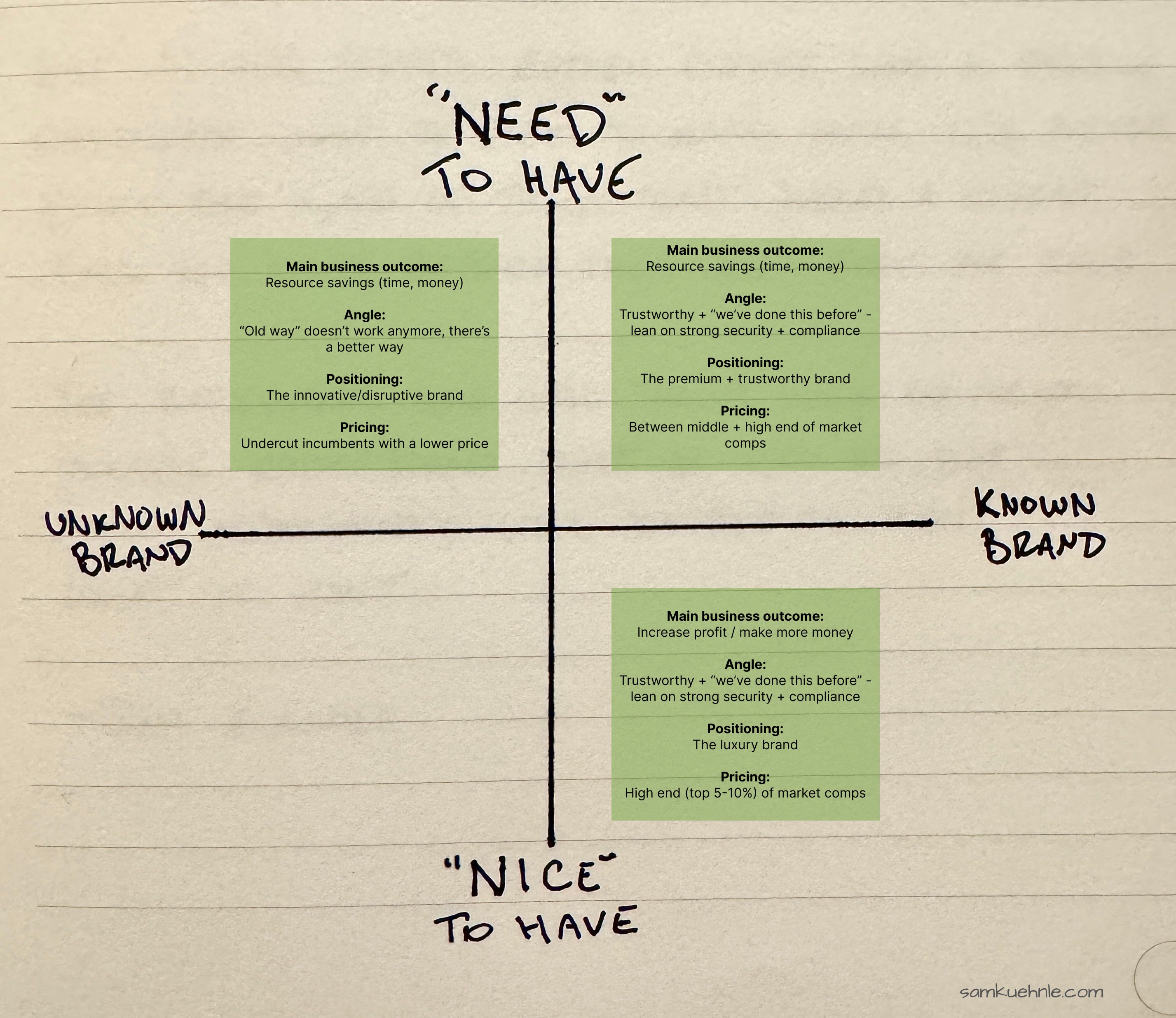
Nice to have x known brand
Alright, so your market knows who you are, but they don’t necessarily need to use you in order to operate.
For those in the tech world, examples of this combination would be something like a revenue attribution tool (e.g. Dreamdata) or direct mail/gifting tool (e.g. Sendoso). A company can fully operate without either of these, but when you have the data or capabilities of something like these, they can drive increased growth.
Now for the 4 mental models…
Main business outcome
Whereas a need to have is often a high-competition/crowded category player, nice to haves typically have fewer options in the space since economic cycles hit nice to haves harder than need to haves. That said, since that means you’re ultimately a “bigger risk, bigger reward” option, the outcome you’ll want to speak to is NOT resource savings, but increasing profits/making more money.
Since the market doesn’t technically need you, your outcome has to be one that basically says “hey, you may not need me, but if you do, you’ll make even more money” (or insert the major business outcome your market seeks). You’re additive to their tech/service stack, so in order to get approved by their finance + leadership team, you need to show the incremental impact you’ll make to their business outcome that makes it a no brainer.
Marketing angle
Similar to being a need to have, this is where we play into being a known brand more. While the market may not technically need your software/services, communicating that you’re a well-known brand + that others like them go with you when they do “splurge” on this nice to have is a card you’ll want to play.
Multiple companies trust you as shown by all of the logos you’ve worked with. You’ve helped so many customers at this point that you have a seemingly never-ending repository of case studies highlighting the results you’ve helped customers achieve. And for winning over the IT + Finance teams, you probably have a very secure + stable infrastructure so they won’t need to worry about downtimes or not meeting compliance.
This one isn’t sexy, but it doesn’t need to be. Very few companies are truly well-known or carry a strong reputation, so don’t be shy about pointing to your track record.
Brand positioning
I think this is the most underrated AND biggest opportunity place to be.
You aren’t needed, BUT you can drive disproportionate outcomes for those who choose to use you. This is the perfect formula for positioning yourself as a luxury brand.
No one needs a watch in today’s day and age, but Rolex absolutely dominates their category.
No one needs a luxury car when a regular car can get you from point A to B, but Rolls-Royce is the only option because of the quality + signal they give.
So when it comes to being a nice to have + you’re a well-known brand, make DAMN sure you’re providing as high-quality of a product/service as you can + orient everything around that. That becomes your moat. Anyone can enter the category if they want, but they’ll have to find a way to overcome your reputation + service level to dethrone you (aka gooooood luck with that).
Pricing
Building off the luxury positioning, I think you already know what I’m going to recommend here. You aren’t a necessity + you’re viewed as a luxury, so price accordingly. You should be aiming for the high end of the market (e.g. top 5-10% minimum).
The market is buying your reputation as they know they’ll be getting a white-glove experience/premium results. Instead of me trying to give a bad example of pricing psychology, I’ll let this passage from Claude Hopkins provide you with how + why this works:
We learned that people judge largely by price. They are not experts. In the British National Gallery is a painting which is announced in the catalog to have cost $750,000. Most people at first pass it by at a glance. Then later, they learn what the painting cost. They return and surround it. A department store advertised $100 hat, and the floor could not hold the women who came to see it. We often employ this factor. Perhaps we are advertising a valuable formula. To merely say that would not be impressive. So we state as a fact that we paid $100,000 for that formula. That statement, when tried, has won a wealth of respect.
Nice to have x unknown brand
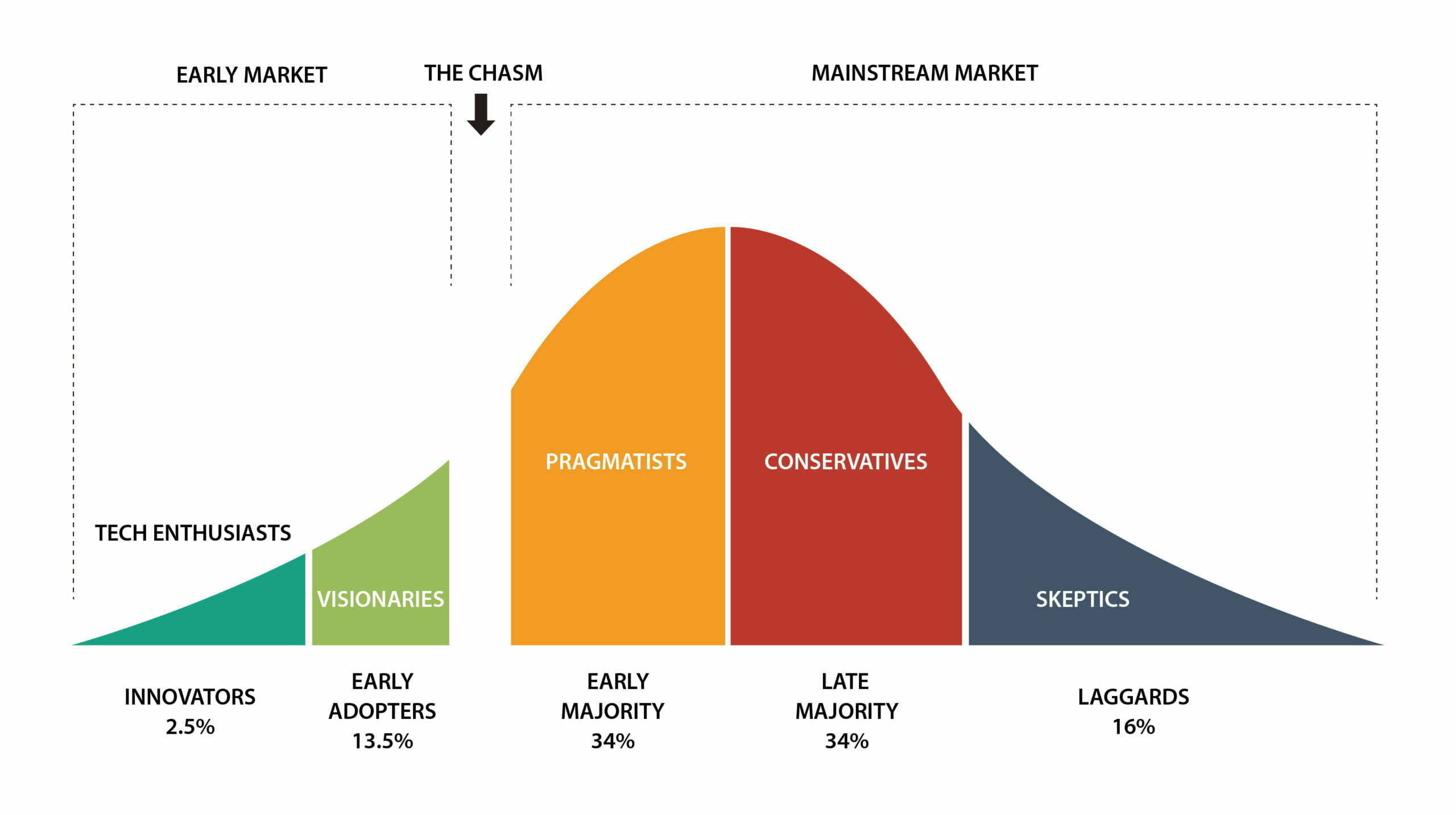
And now we’re on the other side of the known/unknown spectrum inside of the nice to have space. The market doesn’t need you AND they don’t know you. (Wait, why are we doing this again???) Kidding, but you can see that our work is cut out for us in this quadrant.
Keeping the examples going from earlier for those in the tech world, examples of this combination might be something like a company that sends “handwritten” letters on your behalf to prospects/customers (e.g. lettrlabs).
Now for the 4 mental models…
Main business outcome
Like the known brand in a nice to have space, you’re still a “bigger risk, bigger reward” option, so the outcome you’ll want to speak to is NOT resource savings, but increasing profits/making more money.
The market still doesn’t need you, nor do they even know you, so your promised outcome has to be an even more emphatic “hey, you may not need me, but if you do, you’ll make even more money” (or insert the major business outcome your market seeks). You’re additive to their tech/service stack, so in order to get approved by their finance + leadership team, you need to show the incremental impact you’ll make to their business outcome that makes it a no brainer.
Marketing angle
This is a tricky line to navigate, but what I’ve found is that if you want to be successful in this quadrant, you need to lean toward the extreme ends of the spectrum as you’re getting things started.
While the known brands are relying on their reputation + time in the space, the upstarts here have a window in time where they can come in with “fresh eyes” or a unique + strong POV.
The “old way/new way” angle that works for need to haves doesn’t quite hit the same as a nice to have since they aren’t forced to use the tool/service + risk being left behind if they don’t. So this is where I usually go with one of two options:
Cost of inaction - what is the prospect leaving on the table if they don’t use you. Showing how much more money could be made + how that compounds over time can be quite compelling…
Get an edge on your competitors - you’re new + you’re a nice to have. That means 99.9% of companies aren’t using you…yet. Get a little cocky here + demonstrate confidence that you know you’ll be a major player as the years go on, so now is the time for a prospect to get a leg up on their competitors by getting started with you today.
Brand positioning
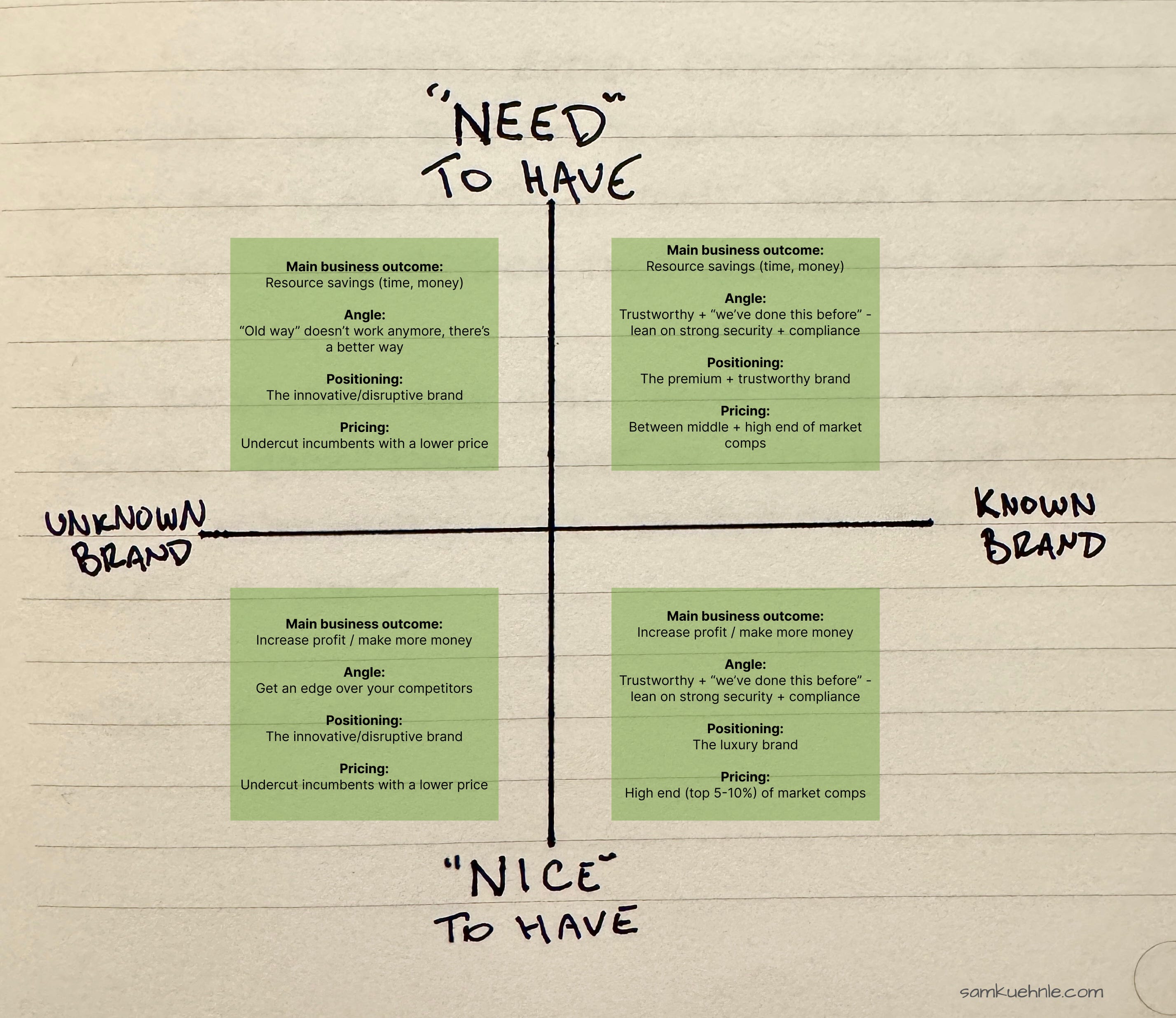
Similar to in the need to have space, you should still have fun with this one + one that can be done any number of ways. There’s no one best way to do this, but one that I’ve seen consistently work well is positioning yourself as an innovator/disruptor to the space. It works well with both the cost of inaction angle, the edge on your competitors angle AND the technology adoption lifecycle curve by attracting the innovators + early adopters. Like I noted in part 1 for the need to haves, while this group may only make up 16% of the total market, they’re the ones who help build some serious momentum + positive word of mouth, so the faster you can attract them + allow them to be more successful than they were with their previous vendor, the faster your acquisition flywheel will go.
As a bonus, when you choose to position yourself as innovative + disruptive, that allows for you to be more aggressive with your branding + have a strong POV to communicate to the market. But instead of going too against the grain + divisive, knowing the long-term goal is to be a well known brand in a nice to have space, you’ll want to have an end goal of being positioned as a luxury brand, so that’s what you’ll want to really lean into with early positioning.
Pricing
So we’re in a nice to have space that may not be too crowded, but doesn’t have a ton of buyers all the time either. We’re going after the innovators + early adopters who are willing to take more risk in order to capture an increased reward on the backside of it.
In order to capture marketshare in a reasonable time + convert the business-oriented decision makers signing the contract, one thing that almost always makes it more palatable for them is if the cost is one that won’t cause any major issues should things not pan out. You don’t want to go crazy and severely undercut the competition as you’ll be viewed as a discount product/service, but being able to say to a prospect that they’ll save 10-25% from what they’re currently paying for the same/better outcomes can be compelling. Or, if they aren’t using anything yet, by showing how quickly they’ll 1) breakeven and then 2) become profitable after getting started with you, is a good way to dispel any potential concerns they have.
Note: make sure you run the numbers on your overhead + acquisition costs so you aren’t looking at a CAC payback period that’ll have you upside down for 3+ years. Technology + knowledge is advancing faster + faster, so whereas many companies used to be changing key providers maybe once every 5-8 years, this has moved to a 2-4 year window now, so if you aren’t profitable within that time, your business won’t be around for too long…
Bonus: how to identify + leverage your unique force multiplier (aka your brand coefficient)
Whether you already are a known brand OR are a relatively unknown brand, what you’re known for + the reputation you carry can quickly erode (for known brands) or be built (for unknown brands).
While few products/services ever move from truly nice to have to a need to have, one thing that is VERY much in a company’s control is their movement from an unknown brand to a known brand.
Why this is important is because of what I call the brand coefficient.
Quick: you need to make a recommendation for a sales CRM for your company RIGHT now, who are you recommending?
That’s brand at play.
I’ve spent years optimizing funnels and improving all of the demand levers available to us.
Cost per demo? Tighten the targeting to true ICP + watch wonders happen.
Demo - SQO rate? Let the prospect schedule the date/time of the demo when filling out the form.
The list goes on + on. But when you zoom out + look at larger datasets, there’s also a more binary variable that I can apply to quickly assess how strong a company’s funnel is:
Their brand coefficient.
If no one knows who you are or they don’t trust you, you can have all of the right demand optimizations built into your funnel, but it’ll still be a weak funnel.
Then on the flip side, if you have a strong brand + people trust you, you can have just some of the right demand optimizations built into your funnel and/or mediocre demand gen tactics in play, and it’ll be a stronger funnel than the one above.
This is the X-factor that takes a prospect from “I know what you do + I know why I should choose you”
to
“I know what you do + I know why I should choose you + I want to choose you.”
This is the force multiplier (aka coefficient) of having a strong brand.
There’s no one right way to build your brand coefficient - it’s unique for every company.
Some companies do it through high-touch, high-quality service (think: Four Seasons)
Some companies do it through a very unique personality (think: Duolingo)
Some companies do it through an emphasis on expert knowledge (think: Refine Labs)
Once you recognize what yours is (or could be), start rolling that snowball. It’ll take time to build up, but that single factor will be what gradually widens your funnel, improves your conversion rates, makes sales conversations easier, and turns raving customers into your biggest acquisition channel as they tell peers about you.
Quick question before we wrap:
See you next week,
Sam
Good one Sam.